Scapular Dyskinesis: When Shoulder Pain Starts at the Shoulder Blade
Scapular dyskinesis is abnormal movement or positioning of the shoulder blade during arm motion. Because the shoulder blade is the platform the entire arm moves from, a platform that is not working properly puts everything attached to it under abnormal stress.
You may also see this written as scapular dyskinesia. The two spellings refer to the same condition and are used interchangeably, including in the medical literature.
One point of definition matters before anything else. Scapular dyskinesis is best understood as a physical impairment rather than a diagnosis - an alteration in how the shoulder blade moves, which has an underlying cause, rather than a disease in its own right. That distinction is not academic. It means the useful question is never simply “do you have scapular dyskinesis,” but what is causing it, and is it contributing to your symptoms. A great deal of the confusion in this area - including published studies that appear to contradict each other - comes from treating it as a diagnosis when it is a finding.
Two groups account for most of the cases I see: overhead athletes, and people who work at a computer. The second group surprises patients, but the mechanism is straightforward and is described in detail below.
It is one of the most under-recognized contributors to shoulder pain, for two reasons. It does not appear on an MRI - there is no scan that shows it, because it is a problem of movement rather than of structure. And it is frequently a consequence of another shoulder problem as well as a cause of one, which makes it easy to attribute the symptoms elsewhere.
If you have been told your MRI is normal and your shoulder still hurts, scapular mechanics are one of the things that should be assessed. A normal scan is a useful piece of information, but it does not mean nothing is wrong - it means nothing structural showed up on that particular test.
Why the Shoulder Blade Matters This Much
The shoulder blade is not fixed to the skeleton in the way most bones are. Its only bony connection to the rest of the body is a small joint where the collarbone meets it. Everything else is muscle. It floats on the back of the ribcage, held and moved entirely by seventeen muscle attachments.
That arrangement gives the scapula an essential set of jobs:
It’s the platform. The socket of the shoulder joint is part of the scapula. When you raise your arm overhead, the scapula must rotate upward roughly 60 degrees to keep the socket oriented underneath the ball. If it doesn’t, the humeral head is asked to move against a socket that’s pointing the wrong way.
It sets the space. Scapular position determines the clearance between the acromion and the rotator cuff tendons. A scapula that fails to rotate upward and tilt backward narrows that space during overhead motion.
It transfers force. In throwing, serving, and swimming, the scapula is the link that transmits power generated in the legs and trunk out to the arm. Poor scapular control means the arm has to generate force it wasn’t designed to generate alone.
It anchors muscles. Rotator cuff muscles originate on the scapula. A muscle firing from an unstable base produces less force and works harder to do it.
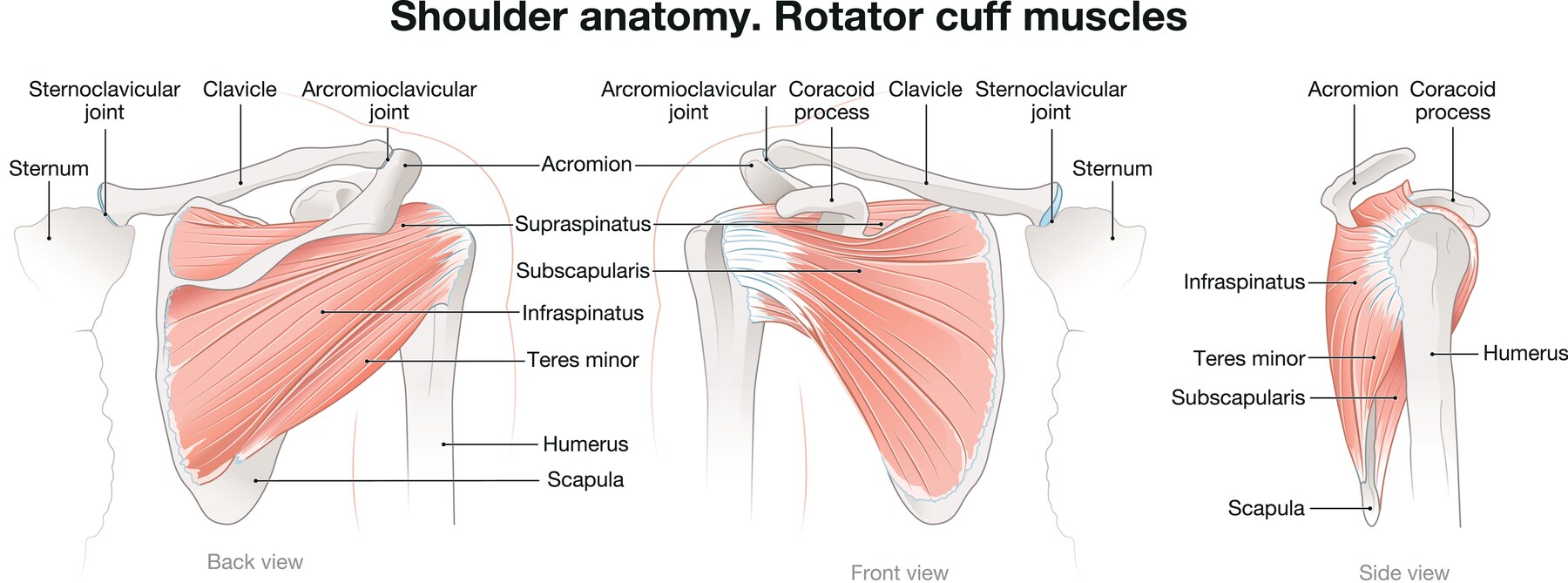
Caption: The rotator cuff muscles originate on the shoulder blade. All four - the supraspinatus across the top, the infraspinatus and teres minor behind, and the subscapularis at the front - take their origin from the scapula and attach to the top of the arm bone. That is why scapular position and cuff function cannot be separated. When the shoulder blade is not held and moved correctly, these muscles are being asked to work from a base that is shifting underneath them.
What Causes It
Muscle weakness and imbalance is the most common driver. The serratus anterior and lower trapezius - the two muscles primarily responsible for upward rotation and posterior tilt - are frequently weak or poorly recruited, while the upper trapezius becomes dominant and overworked.
But weakness at the back is usually only half the problem. The muscles across the front of the chest - pectoralis major and pectoralis minor - sit on the opposite side of the same mechanical system. When they shorten and tighten, they pull the shoulder blade forward and tip it into a protracted, anteriorly tilted position. The posterior muscles are then being asked to work from a disadvantaged position against a structure that is actively being held the wrong way.
This is why strengthening alone often fails. A patient can do scapular strengthening diligently for months and improve very little if the front of the chest is never addressed, because the muscles being trained are working against a mechanical restraint that has not changed. Restoring length at the front and building strength at the back are two halves of one problem, and the order matters - mobility before strengthening.
Postural adaptation, and why desk work drives this. Prolonged sitting at a computer produces a predictable pattern: rounded shoulders, forward head, shoulder blades drifting forward, pectoralis minor shortening. Held for eight hours a day over years, that becomes the resting position, the front tightens into it, and the back weakens to match. The published literature identifies computer users alongside overhead athletes as the two highest-risk groups for this condition, and that matches what I see in clinic.
Pain inhibition. This mechanism is less widely appreciated: a painful shoulder alters how the surrounding muscles fire, and scapular control degrades as a result of pain, not only as a cause. This is why scapular dyskinesis is so common alongside rotator cuff disease, instability, and labral problems - and why treating only the scapula, without addressing the underlying problem, sometimes fails.
Stiffness. A tight posterior capsule, a short pectoralis minor, or a stiff latissimus dorsi mechanically restricts normal scapular motion. Latissimus tightness in particular pulls the scapula upward and interferes with its rotation.
Overlap with the neck. The same sustained posture that shortens the front of the chest also flattens the normal curves of the cervical and upper thoracic spine. That is why scapular dyskinesis and neck-related shoulder pain frequently occur in the same patient, and why the two can be difficult to separate - a desk worker may have a genuine mechanical neck problem, genuine scapular dysfunction, and symptoms that overlap across both.
This matters for treatment. If scapular rehabilitation is only partially helping, the neck deserves examining, and vice versa. It also means the resting position of the whole spine belongs in the treatment plan rather than just the shoulder blade. See the page entitled “Is Your Shoulder Pain Actually Coming From Your Neck?” for how the two are interrelated and how they can be told apart.
Nerve injury. Less common but important. Long thoracic nerve palsy causes serratus anterior weakness and medial scapular winging; spinal accessory nerve injury causes trapezius weakness and lateral winging.
A note on the word “winging,” which is frequently used loosely. It is best reserved for altered scapular motion caused by nerve injury, and it looks distinctly different: the scapula departs from the ribcage immediately as the arm starts to move and stays off it throughout, both raising and lowering. Scapular dyskinesis from muscle imbalance or poor control looks different - the prominence appears during movement, usually most obvious as the arm comes down, and is not present throughout. If someone has told you your shoulder blade “wings,” it helps to establish which of these they meant.
Sport-specific adaptation. Overhead athletes develop characteristic scapular patterns from years of repetitive loading - some adaptive and useful, some problematic.
Symptoms

Caption: Overhead athletes are one of the two highest-risk groups, alongside people who work at a computer. In swimmers the pain is typically felt at the back or outer shoulder, builds through a session as the muscles controlling the shoulder blade fatigue, and settles with rest.
Scapular dyskinesis often presents as aching pain around or between the shoulder blades, along with shoulder pain that worsens with overhead activity and with sustained postures.
- Aching around, under, or between the shoulder blades
- Shoulder pain with overhead reaching, often described as pinching
- Fatigue and heaviness in the arm with sustained use
- Pain that worsens over the course of a workday and improves with movement or a weekend off
- A visible prominence of the shoulder blade that someone else may notice first
- Snapping or grinding under the shoulder blade with arm movement - when this is prominent and localized, it raises the possibility of scapulothoracic bursitis rather than a purely muscular problem
- Reduced power or accuracy in overhead sport
- Neck and upper trapezius tightness, frequently reported together
Pain Between the Shoulder Blades
This is one of the most common ways scapular dyskinesis presents, and one of the most commonly searched shoulder symptoms. The ache sits medially, between the shoulder blade and the spine, and is typically worse after sustained sitting, worse toward the end of a working day, and eased by movement or by a couple of days away from a desk.
Why it happens there. The muscles that hold the scapula against the ribcage and rotate it upward attach along that medial border. When they are working against a shortened front of the chest, or are being asked to stabilize a scapula that has drifted into a protracted position, they fatigue - and fatigued postural muscles ache exactly where they attach.
What makes it recognizable as a mechanical problem:
- It varies with posture and activity rather than being constant
- It improves with movement and worsens with stillness
- It is often bilateral, or worse on the dominant side
- It coexists with neck and upper trapezius tightness
- Nothing structural appears on imaging
Pain between the shoulder blades is not always coming from the shoulder blades. That region can also be a referral site for problems in the neck, and - less commonly but far more urgently - for conditions in the chest. Pain between the shoulder blades accompanied by chest pain, shortness of breath, sweating, nausea, or a tearing sensation requires emergency evaluation rather than a musculoskeletal appointment. Pain that is constant, unrelated to position, present at night, or accompanied by fever or unexplained weight loss also warrants prompt medical assessment.
Those situations are uncommon, and the great majority of interscapular aching is mechanical. But the pattern should be recognized, because this is one symptom where the serious causes do not resemble the common one. See the red flags section on the neck-versus-shoulder page for the fuller list.
How It’s Diagnosed
Scapular dyskinesis is diagnosed by watching the shoulder blade move, which requires the back to be visible. There is no shortcut here and no test that substitutes for it.
One practical consequence for you: this examination cannot be performed through clothing. If shoulder blade mechanics are a question at your visit, wear or bring something that allows your upper back to be seen - a sports bra, a tank top, or a gown you can turn around. It sounds trivial and it is the difference between the examination happening and not happening.
Several tests assess scapular mechanics, and they examine the shoulder blade both on initial motion and after fatigue - repeating the movement, or adding a light weight, frequently reveals altered mechanics that a fresh shoulder hides. Others involve the examiner manually correcting the position of the shoulder blade to see whether symptoms improve, which is informative because it is effectively a trial of the treatment: if correcting the position helps, training you to correct it yourself is likely to help too.
None of this happens in isolation. These tests are performed in the same visit as the examination for structural problems around the shoulder - rotator cuff and labral testing - and an examination of the spine. That combination is the point. Scapular dyskinesis frequently coexists with other findings, and the purpose of the visit is to work out which of them is producing your symptoms and in what proportion, rather than to confirm any single one.
Mobility is assessed at the same time, since posterior capsular tightness, pectoralis minor tightness, and thoracic spine stiffness all restrict scapular motion mechanically and each changes the treatment plan.
Where imaging fits. There is no scan that diagnoses scapular dyskinesis - it is a problem of movement, and movement is assessed by watching it. But imaging still has a role, and I do order it in two situations.
An MRI of the shoulder, to look for associated conditions in the joint. Scapular dyskinesis rarely travels alone, and knowing whether there is a rotator cuff or labral problem alongside it changes both the treatment and what to expect from it.
An MRI of the scapula, in a narrower set of cases. Scapulothoracic bursitis - inflammation of the tissue between the shoulder blade and the ribcage - can be an underlying cause of scapular dyskinesis rather than a consequence of it, and identifying it matters, because it is treated differently.
What points toward that diagnosis is the character of the symptoms. Patients with scapulothoracic bursitis tend to have more mechanical symptoms localized to the shoulder blade itself - snapping, grinding, or a catching sensation as the shoulder blade moves over the ribs, often audible or palpable - rather than the diffuse aching and fatigue that characterizes scapular dyskinesis from muscle imbalance. If that is the pattern, a scapular MRI is reasonable.
If nerve injury is suspected, EMG rather than imaging is the appropriate test.
Treatment
Scapular dyskinesis is treated with rehabilitation, not surgery, and outcomes are generally good when the program is well designed and followed consistently.
An illustrated home program covering mobility, control retraining, and strengthening, with dosing, cues, and the common errors for each exercise. This is the handout I give patients in clinic.
A more general Shoulder Conditioning Program from the AAOS is also available. Neither replaces a program tailored to your own examination - your therapist should adapt it to what is actually going on in your shoulder.
Restore mobility first. Tight structures physically prevent normal scapular motion, so stretching precedes strengthening. Priorities are the pectoralis major and minor, the posterior capsule (cross-body adduction), the thoracic spine, and the latissimus dorsi.
Then retrain control. Conscious scapular positioning, taught before it is loaded. This is a motor learning problem as much as a strength problem - patients need to be able to feel where their shoulder blade is before they can control it.
The published rehabilitation framework describes three sequential stages - active conscious control, then strength and control for daily activities, then control in athletic performance - which is the structure the program below follows.
Then build control before strength - and this is where thinking has shifted.
The traditional approach to this condition was isolated strengthening: prone Y, T and W raises, band rows, serratus punches. Current expert guidance argues that motor control, rather than strength, should be the primary target, and the reasoning is persuasive.
Part of the problem is that you cannot see your own shoulder blade. Most joints are corrected using visual feedback - you can see your hand, your knee, your foot. The scapula sits on the back of the ribcage where it cannot be seen, and the absence of that feedback loop may be part of why the motion goes wrong in the first place. Deliberately repositioning the shoulder blade before moving the arm - conscious correction - measurably improves both muscle activity and mechanics, and using a mirror or a phone camera helps considerably.
The principles that follow from this change what a good program looks like:
- Short lever first. Begin with the arm held close to the body, not elevated. The further the arm is from the trunk, the harder the scapula has to work, and starting long is starting too hard.
- Standing and sitting rather than lying down. Upright positions let the legs and trunk participate, which is the point - the scapula is a link in a chain, and training it flat on a bench removes the rest of the chain.
- Impairments addressed in order: mobility, then motor control, then strength if it is needed, then endurance.
- No shrugging or scapular elevation for the first four to six weeks. These bias the upper trapezius, which is usually the muscle already doing too much, and reinforcing it delays the balance you are trying to restore.
- Longer-lever and overhead work comes late, and only once the earlier patterns are performed well without provoking symptoms.
The exercises that fit this model keep the arm close to the body and use the trunk, the legs, or body weight to drive the shoulder blade:
- Conscious correction - standing, gently setting the shoulder blades, with visual feedback
- The wall pushup - a closed-chain exercise performed against a wall, where the work that matters is the final press away once the elbows are already straight, which recruits the serratus anterior
- The lawnmower - standing up out of a forward-bent position with hip and trunk extension and rotation, the arm staying close to the body
- The robbery - bringing the hands up to chest height with the elbows held against the ribs, drawing the shoulder blades down and back
- The fencing exercise - beginning with the arm out to the side at shoulder height and stepping sideways while the arm comes down and in and the shoulder blade retracts. This is the late-stage exercise, because it is the one in which the arm starts furthest from the trunk
On dosing, the guidance is more conservative than most people expect. Start with three sets of ten repetitions and no resistance at all, and build upward toward five sets - adding a set only when the current number is completed without fatigue and without form deteriorating. Fatigue is the limit that matters: if the last repetitions of a set are noticeably worse than the first, that is the ceiling for now. Reaching five comfortable sets is the signal to introduce resistance.
When resistance is added, light free weights of two to three pounds come before elastic bands. A band’s resistance varies through the range and is harder for a patient to control as arm position changes, whereas a free weight is predictable. The published recommendation is more aggressive on volume than the figures above - I have set the starting point lower deliberately, because a program that feels punishing gets abandoned.
Feedback helps, but not without limit. Mirrors, video, and hands-on cueing all improve scapular muscle activation. Too much of it becomes a crutch - the goal is a shoulder blade that behaves correctly when nobody is watching and no mirror is present.
Address the resting position of the spine. Retraining a neutral spinal position - working from the lumbar spine upward through the thoracic and then the cervical - re-engages the paraspinal muscles that support the whole system, and is practiced in short bursts many times a day rather than as a set of exercises. For desk workers in particular this matters as much as the shoulder blade work itself.
Integrate the kinetic chain. Hip and trunk strength genuinely affect scapular control in overhead athletes. A program that stops at the shoulder blade is incomplete for anyone who throws, serves, or swims.
Address the workstation. Monitor at eye level, forearms supported, and - most importantly - regular movement breaks. Posture advice without movement breaks rarely changes anything; the best posture is the next one, and the problem with desk work is sustained position more than any specific position.
Timeline. Published programs average around twelve weeks and report satisfactory functional outcomes at that point. Athletes with high overhead demands often need longer - three months or more. Most patients notice meaningful change somewhere between six and twelve weeks. Like most motor control problems, this responds to frequent short sessions better than occasional long ones.
One caution from the research that is rarely mentioned: the gains from conscious motor retraining can be lost if the training stops. This is not a course of treatment that is finished and forgotten - some maintenance work, and attention to the postures that caused the problem, keeps the result.
Why the older approach often disappointed. Isolated strengthening exercises are single-plane by design and give the patient nothing to focus on but the muscle. They do not rebuild the sequencing between trunk, hip, and shoulder that produces normal scapular motion in real activity. That is the argument for the integrated approach above - though it should be said plainly that while these recommendations come from expert consensus and are well reasoned, they have not yet been tested head-to-head against traditional strengthening in a randomized trial.
Surgery has essentially no role in isolated scapular dyskinesis. It is relevant only for specific structural problems - symptomatic snapping scapula unresponsive to rehabilitation, or nerve injury requiring reconstruction or tendon transfer in selected cases.
One important caveat. If scapular dyskinesis is secondary to another shoulder problem - a rotator cuff tear, instability, a labral lesion, or a frozen shoulder - that underlying problem needs addressing as well. Scapular rehabilitation alone will only partially help a shoulder whose primary problem is structural.
The reverse is also true and is the more common error in the other direction: treating the structural problem while ignoring the scapula. Scapular control is part of non-surgical rotator cuff treatment and part of rehabilitation after cuff repair, and a program that stops at the tendon is incomplete.
Frequently Asked Questions
What is scapular dyskinesis?
It is abnormal movement or positioning of the shoulder blade during arm motion. The condition is also written as scapular dyskinesia - the two spellings mean the same thing. Because the shoulder blade is the platform the arm moves from, abnormal scapular mechanics can cause pain, reduce strength, and contribute to rotator cuff and labral problems.
Can bad posture really cause shoulder pain?
Sustained postures can. Prolonged rounded-shoulder positioning shortens the pectoralis major and pectoralis minor across the front of the chest, which pulls the shoulder blade forward and tips it. The muscles at the back - serratus anterior and lower trapezius - are then working from a disadvantaged position, and they weaken. What matters most is not any single “correct” posture but avoiding sustained positions: regular movement breaks change more than ergonomic adjustments alone. Computer users are identified in the literature alongside overhead athletes as one of the two highest-risk groups for this condition.
Why does strengthening my shoulder blade muscles not seem to help?
One common reason is that the front of the chest has not been addressed. Tight pectoralis major and pectoralis minor hold the shoulder blade in a forward, tipped position, and strengthening the muscles at the back while that restraint remains means training them to work against a mechanical disadvantage. Restoring length at the front and building strength at the back are two halves of the same problem, and mobility generally needs to come first. The other common reasons are an underlying structural problem the exercises cannot address, and a program that has not been done frequently enough - this responds to short daily sessions rather than occasional long ones.
How do I know if I have scapular winging?
Winging is when the inner border of the shoulder blade lifts away from the ribcage. It is often easiest to see when pushing against a wall or lowering the arm from overhead, and someone else usually has to look. True winging can indicate nerve injury and should be evaluated by a physician; milder prominence is more often muscular.
Does scapular dyskinesis show up on an MRI?
Not directly. It is a disorder of movement rather than of structure, and it is diagnosed by watching the shoulder blade move. That said, imaging is often still useful. An MRI of the shoulder looks for associated conditions in the joint - rotator cuff or labral problems that commonly accompany it and change the treatment. An MRI of the scapula is ordered in narrower circumstances, most often when scapulothoracic bursitis is suspected as an underlying cause. Patients with that condition usually have more mechanical symptoms localized to the shoulder blade itself: snapping, grinding, or catching as it moves over the ribs, rather than diffuse aching and fatigue.
How long does it take to fix scapular dyskinesis?
Most people notice meaningful improvement within six to twelve weeks of consistent rehabilitation, with continued gains beyond that. It responds better to short frequent sessions than to occasional long ones, because it is as much a motor control problem as a strength problem.
Is scapular dyskinesis a diagnosis?
Not exactly, and the distinction is useful. It is best understood as a physical impairment - an alteration in how the shoulder blade moves - rather than a disease in itself. Something causes it: tight muscles at the front of the chest, weakness or poor recruitment at the back, pain from another shoulder problem, a stiff thoracic spine, or occasionally a nerve injury. The useful question is not whether you have scapular dyskinesis but what is producing it and whether it is contributing to your symptoms.
Should I be doing strengthening exercises or something else?
Current expert guidance favors motor control before strength. The reasoning is that you cannot see your own shoulder blade, so the feedback loop that normally corrects joint position is missing - which may be part of why the motion goes wrong. Programs built around conscious repositioning, using the legs and trunk to drive the shoulder blade, and starting with the arm close to the body appear to make more sense than isolated strengthening in a single plane. Practical implications: start with no resistance at all and build volume before load, avoid shrugging movements for the first four to six weeks because they reinforce the muscle that is usually already overworking, and use a mirror early on. When weight is eventually added, light free weights come before resistance bands - a band’s resistance changes through the range and is harder to control.
Do I need surgery for scapular dyskinesis?
Almost never. It is treated with rehabilitation. Surgery is relevant only for specific structural causes such as symptomatic snapping scapula that hasn’t responded to rehabilitation, or nerve injuries requiring reconstruction.
What causes pain between the shoulder blades?
Most often it is mechanical - the muscles that hold and rotate the shoulder blade fatiguing where they attach along its inner border, typically after sustained sitting or desk work. Mechanical pain of this kind varies with posture and activity, improves with movement, worsens with stillness, and does not show up on imaging. The region can also refer pain from the neck. Less commonly, interscapular pain arises from conditions in the chest: pain between the shoulder blades with chest pain, shortness of breath, sweating, nausea, or a tearing sensation needs emergency evaluation, as does pain that is constant, unrelated to position, or accompanied by fever or unexplained weight loss.
Why does my shoulder hurt more at the end of the workday?
That pattern points toward a postural or muscular cause rather than a structural one. Muscles holding a sustained position fatigue over hours, which is why the pain builds through the day, eases with movement, and is often better after a weekend. A structural problem such as a rotator cuff tear tends to hurt with specific movements - reaching overhead, lying on that side - rather than accumulating with time spent still.
Is scapular dyskinesis the cause of my shoulder pain or a result of it?
It can be either, and frequently it’s both. Abnormal scapular mechanics can contribute to rotator cuff and labral problems, and pain from those problems can in turn degrade scapular control. This is why an evaluation should assess both the scapula and the joint itself rather than assuming one explains everything.
Shoulder pain with a normal MRI?
Dr. Gabriella Ode is a fellowship-trained shoulder and sports medicine surgeon at the HSS Sports Medicine Institute. A complete shoulder evaluation includes assessment of scapular mechanics - because a normal MRI does not mean there’s nothing wrong. Request an appointment or request a remote second opinion.
References
- Panagiotopoulos AC, Crowther IM. Scapular Dyskinesia, the forgotten culprit of shoulder pain and how to rehabilitate. SICOT-J. 2019;5:29.
- Kibler WB, Sciascia AD. Current Views of Scapular Dyskinesis and its Possible Clinical Relevance. Int J Sports Phys Ther. 2022;17(2).
- Cools AMJ, Struyf F, De Mey K, Maenhout A, Castelein B, Cagnie B. Rehabilitation of scapular dyskinesis: from the office worker to the elite overhead athlete. Br J Sports Med. 2014;48:692–697.
Financial disclosure.
Dr. Ode is a paid consultant for Advita Ortho and ConMed, manufacturers of orthopaedic implants and surgical instrumentation. These relationships are reported publicly through the CMS Open Payments database. She receives no compensation for this website, and no compensation is tied to any individual patient’s treatment decision. Her complete financial disclosures are available here.
This article is for general education and is not a substitute for individual medical advice. Please consult a physician about your specific condition.