- Shoulder Replacement
- Reverse Shoulder Replacement
- Revision Shoulder Replacement
- Computer Navigation for Shoulder Replacement
- GPS-guided Shoulder Replacement
- Outpatient Shoulder Replacement
Shoulder Replacement Specialist in Brooklyn, New York
Arthritis of the shoulder can cause pain, swelling and stiffness in the joint. The condition is treated by removing the damaged articulating parts and replacing them with prostheses. Gabriella Ode, MD, Orthopedic Surgeon, Sports Medicine Specialist provides expert diagnosis and individualized non-operative and operative treatments for the shoulder including shoulder joint replacement in Brooklyn, New York. Gabriella Ode, MD, Orthopedic Surgeon, Sports Medicine Specialist also provides highly specialized care during and after surgery. Contact Gabriella Ode, MD, Orthopedic Surgeon, Sports Medicine Specialist’s team for an appointment today!

Total Shoulder Replacement: What It Is and Who It Helps
An anatomic total shoulder replacement resurfaces both sides of the arthritic shoulder joint in their normal configuration - a metal ball replaces the worn humeral head, and a plastic socket resurfaces the glenoid. It is one of the most reliable operations in orthopaedic surgery for relieving arthritis pain, with the great majority of patients reporting substantial, lasting improvement.
The word anatomic is the key. It distinguishes this procedure from a reverse total shoulder replacement, where the ball and socket are deliberately switched. Both are excellent operations. They are for different shoulders, and understanding which one applies to you is the most important part of this conversation.
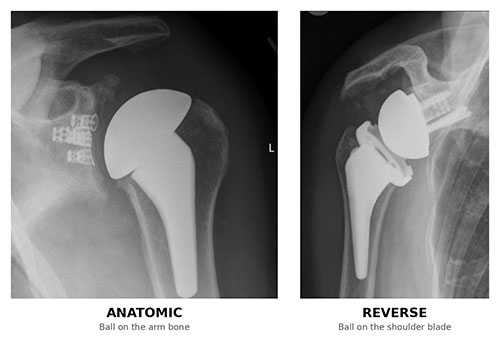
Caption: Anatomic (left) and reverse (right) total shoulder replacement, side by side. In the anatomic replacement the ball sits on the arm bone and the socket on the shoulder blade, as in a normal shoulder. In the reverse, those positions are switched - the ball is fixed to the shoulder blade and the socket to the top of the arm bone.
Who is a candidate?
An anatomic total shoulder replacement is appropriate for a patient with glenohumeral arthritis, an intact and functioning rotator cuff, and enough glenoid bone to support a socket implant. The rotator cuff requirement is not negotiable - in an anatomic replacement, the rotator cuff is what holds the ball centered in the socket and powers rotation. Without it, the implant fails.
You are likely a reasonable candidate if:
- X-rays show glenohumeral arthritis with joint space loss
- Your rotator cuff is intact on examination and imaging
- Pain limits sleep and daily activities despite non-surgical treatment
- Your glenoid bone stock and version are within a range that will accept a socket component
Situations that point instead toward a reverse replacement:
- A large or irreparable rotator cuff tear
- Cuff tear arthropathy
- Severe glenoid bone loss or extreme retroversion
- Prior failed rotator cuff surgery with persistent weakness
- Certain complex fracture and revision scenarios
Age is a factor but not a rule. Younger patients place higher demands on an implant and have more years for it to wear, so the threshold for surgery is higher and the discussion about activity expectations is more detailed. That said, an anatomic replacement can be entirely appropriate in a patient in their fifties with the right anatomy and the right expectations.
Why I order an MRI before an anatomic replacement. An MRI is not routinely needed to diagnose shoulder arthritis - X-rays and examination do that. But when I’m considering an anatomic total shoulder replacement specifically, I want assurance that the rotator cuff can support that implant.
The value of the study is asymmetric, and it’s worth being precise about. An MRI cannot definitively guarantee a rotator cuff will function well for years to come - how a tendon looks on imaging and how it performs under load are related but not identical. What it reliably does is rule people out. If the scan shows significant rotator cuff tearing, an anatomic replacement is off the table, and we know that in advance rather than discovering it during surgery or watching the implant fail later. Identifying who shouldn’t have this operation is the practical reason to obtain it.
A CT scan is obtained separately, for surgical planning - it defines glenoid bone shape, version, and generates the three-dimensional model used for navigation.
What happens during the operation
The operation itself takes one to two hours - but plan on considerably longer in the operating suite. Before surgery begins, anesthesia has to be administered, and you have to be positioned and prepped. Afterwards, you need to be woken from anesthesia and transported to the recovery room. All of that happens inside the operating suite and is part of the day, so the total time you’re away from your family is meaningfully longer than the surgical time itself.
This is worth knowing in advance, because families waiting are often working from the “one to two hours” figure and start to worry when it passes. Ask your surgical team what to expect for total time, and let whoever is waiting know.
Surgery is often performed under either moderate sedation or general anesthesia, combined with a nerve block. The block numbs the surgical extremity during the operation and for several hours afterwards, which dramatically reduces the pain of the first night.
The sequence:
- Approach. An incision is made at the front of the shoulder, and I work through the natural interval between the deltoid and pectoralis muscles - the deltopectoral approach - which avoids cutting through the deltoid.
- To reach the joint, the subscapularis must be released. This is the rotator cuff tendon at the front of the shoulder, and it sits directly over the joint. I release it in one of two ways: a tenotomy, cutting across the tendon itself, or a peel, taking the tendon off the bone at its attachment. In both, the subscapularis is cut - and in both, it is repaired at the end of the operation.
- This matters to you because that repair has to heal. It is the reason for several of the restrictions in your first six weeks, particularly the limits on rotating the arm outward and on pushing up out of a chair with the operated arm.
- Humeral preparation. The arthritic humeral head is removed and the bone shaped to accept the implant stem.
- Glenoid preparation. The worn socket is prepared and the plastic component seated. This is the technically demanding part of the operation - see below.
- Trial and implantation. Trial components confirm stability, motion, and appropriate soft-tissue tension before the final implants are placed.
- Closure. The subscapularis is repaired and the wound closed in layers.
Many shoulder replacements are now performed with a same-day or overnight stay, depending on your medical history and home circumstances.
Stemmed or stemless: two ways to fix the humeral side
Patients are often surprised to learn there is a choice here, and it’s worth understanding because the two implants look quite different on an X-ray.
A stemmed implant has a metal stem that extends down inside the shaft of the humerus, anchoring the component in the bone below. This is the long-established design, with decades of outcome data behind it.
A stemless implant anchors entirely within the top of the humerus, with no stem down the shaft. It preserves more of your own bone, and because there is no stem to remove, a future revision operation is generally simpler if one is ever needed.
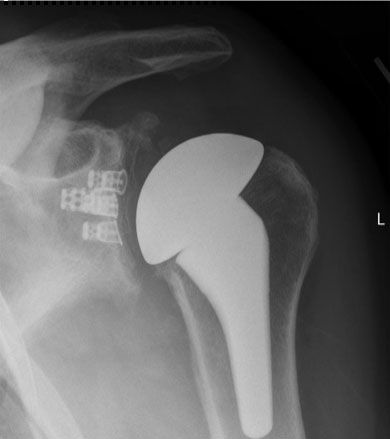
Caption: Anatomic total shoulder replacement with a stemmed humeral component. The stem extends down into the shaft of the humerus.
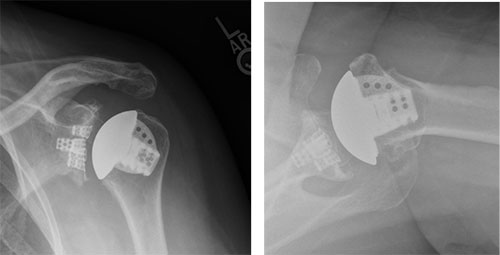
Caption: Anatomic total shoulder replacement with a stemless humeral component, shown on AP and axillary views. The component is anchored entirely within the top of the humerus.
Which one is right for you depends mainly on your bone quality. A stemless implant requires dense enough bone at the top of the humerus to hold securely; where that bone is soft or deficient, a stem provides more reliable fixation. Prior fracture, deformity of the humerus, and revision situations also push toward a stemmed design.
This is a decision made with your imaging in hand, and often confirmed during the operation itself once the bone can be assessed directly.
Why glenoid positioning determines the result
The socket component is small, thin, and fixed to a bone that is frequently eroded asymmetrically by the arthritis itself. Decades of registry data point to the same conclusion: glenoid component loosening is the leading cause of failure in anatomic total shoulder replacement, and malposition is a major driver of loosening. A component placed in excessive retroversion or with inadequate bone contact is under mechanical disadvantage from the day it goes in.
Getting this right requires knowing the three-dimensional shape of your glenoid before surgery - which a plain X-ray cannot show - and then reproducing the plan accurately in the operating room.
This is why I perform shoulder arthroplasty using computer navigation. A preoperative CT scan is converted into a three-dimensional model of your specific anatomy, and the plan for implant size, position, version, and inclination is made before the day of surgery. During the operation, the AdvitaGPS navigation system tracks the instruments in real time and confirms that what was planned is what is actually being done.
In a published analysis of more than 16,000 navigated shoulder cases, 98% were completed as planned, with implant placement verified to within roughly 2 mm and 2 degrees of the preoperative plan. By number of navigated cases performed, I am among the top 5% of surgeons worldwide.
Full detail: Computer-Navigated Shoulder Replacement · Manufacturer information: AdvitaGPS Shoulder
Recovery: what the year actually looks like
Most patients are out of the sling by six weeks, driving between four and six weeks, and doing most daily activities comfortably by three months. Strength and endurance continue improving for a full year.
How I use the sling: 4 to 6 weeks
Patients almost always want to know exactly when the sling comes off, so here is the protocol I use after an anatomic total shoulder replacement, in detail.
Weeks 0 to 4 - sling on, with two specific exceptions.
Wear the sling whenever you are walking around your home, whenever you are sleeping, and any time you leave the house.
You may take it off for two things:
- Showering
- Sitting. When you are awake and seated in a chair where your arm and elbow can rest supported on an armrest, the sling can come off. This begins once the nerve block has worn off and sensation and movement have returned to your arm.
If you get up from that chair to walk anywhere - even a few steps - put the sling back on. This is the rule patients most often let slide, and it’s the one worth being strict about.
Weeks 4 to 6 - sling for sleep and for leaving the house.
You no longer need the sling to walk around your own home. You should still wear it while sleeping and any time you go out.
Here’s how I explain that to patients: the sling in this phase is for protection in uncontrolled environments. When you’re asleep, you can’t control how your arm moves. When you’re outside the house, there are variables you don’t control either - an uneven sidewalk, someone bumping into you in a crowd. Those are the settings where I want the extra protection, and they’re exactly the ones people underestimate.
End of week 6 - the sling is discontinued entirely.
My full written physical therapy protocol for anatomic total shoulder replacement is available here: Total Shoulder Arthroplasty PT Protocol (PDF)
This is the same document I give your physical therapist. You are welcome to read it, though it is written for clinicians and is more detailed than most patients need.
Alongside the sling protocol:
Weeks 0 - 2. Gentle elbow, wrist, and hand movement starts immediately. Pain is managed with a multimodal regimen; the goal is to minimize opioid use, and most patients need them only briefly.
On sleeping. Most patients sleep either in bed propped up on pillows or in a recliner. That’s usual - but it isn’t required. As long as you are sleeping in your sling with your arm positioned appropriately, you are safe. There is no single correct position you have to achieve.
What is true is that lying flat is not very comfortable for the first few weeks after surgery, so most people end up propped up simply because it feels better. Finding a position that works for you may take some experimenting, and that’s normal. Sleep is the most commonly reported frustration in the early weeks, and it does settle.
Weeks 2 - 6. Passive and assisted motion under the direction of physical therapy. The key restriction in this window protects the subscapularis repair: no active internal rotation against resistance, no pushing up out of a chair with the operated arm, and no reaching behind your back. These restrictions are the ones patients most often violate accidentally, and they matter.
Weeks 6 - 12. Active motion progresses. Light strengthening begins. Most patients notice a distinct turning point somewhere in this window where the shoulder starts feeling like it belongs to them again.
Months 3 - 6. Progressive strengthening. Return to golf, swimming, and doubles tennis is typically discussed in this period, individualized to how you’re progressing.
Months 6 - 12. Continued gains, particularly in endurance and in the last portion of overhead motion.
Long-term activity. Golf, hiking, cycling, and general fitness are generally well tolerated.
What I do have a firm view on is repetitive heavy lifting and repetitive rotational loading. Both carry a real risk of wearing the implant out early, and that risk is cumulative - it isn’t about whether you can do something once, it’s about what a decade of doing it does to the components.
That category is broader than most patients expect. It includes heavy weight training and repetitive overhead lifting, but also singles tennis and certain swimming strokes - freestyle, backstroke, and butterfly - all of which load the shoulder through repeated rotation under force. Swimming is often described as universally shoulder-friendly, which isn’t quite right; the stroke matters.
One more thing worth being straight about: being cleared to return to an activity is not the same as being able to do it. Published return-to-sport rates after shoulder replacement sit at roughly 80% across most sports, which is genuinely encouraging - but it also means a meaningful minority of patients don’t get back to their sport even after a technically successful operation and full clearance. Comfort, confidence, strength, and endurance all have to come together, and sometimes they don’t.
How long does it last?
Published survivorship for anatomic total shoulder replacement is commonly reported in the range of 90% or better at ten years, meaning roughly nine in ten implants remain in place without revision at that point. Registry data across multiple national joint registries confirm high survivorship over more than a decade of clinical use.
Two honest caveats. Younger and more active patients have somewhat higher revision rates, because more years and more load mean more accumulated wear. And these figures describe populations, not individuals - your bone quality, rotator cuff status, and activity level all influence your own trajectory.
Risks
Serious complications are uncommon, but no operation is risk-free.
Persistent pain after surgery. This one deserves to be stated first, because it is the outcome patients least expect and the one that matters most to them.
Some patients continue to have shoulder pain even after a technically successful replacement. Pain around the shoulder is complicated and multifaceted, and there are a number of possible sources that are not fixed simply by replacing the joint - the neck, the rotator cuff, the biceps tendon, the AC joint, and the mechanics of the shoulder blade among them. A replacement addresses arthritis in the ball-and-socket joint. It does not address everything that can hurt in that region.
This is part of why a careful evaluation before surgery matters so much: the goal is to establish, as confidently as possible, that the arthritic joint really is the source of your pain.
The risk of persistent pain is very small. It is not zero. Any surgeon who tells you otherwise is overpromising.
Other risks:
- Infection - under 1% in most series, but consequential when it occurs
- Glenoid loosening - the most common long-term mode of failure
- Subscapularis failure - if the front rotator cuff tendon does not heal, weakness and instability can result
- Rotator cuff tear over time - a late cuff tear can cause the implant to shift upward and may require conversion to a reverse replacement
- Nerve injury - usually a temporary stretch neuropraxia that resolves
- Stiffness - most often when therapy is delayed or inconsistent
- Periprosthetic fracture, blood clot, anesthetic complications - uncommon (under 1%), but they can still occur
Frequently Asked Questions
What’s the difference between a total shoulder replacement and a reverse shoulder replacement?
In an anatomic total shoulder replacement, the ball stays on the arm bone and the socket stays on the shoulder blade - normal anatomy is restored. In a reverse replacement, the positions are switched: a metal ball is fixed to the shoulder blade and a plastic socket to the arm bone. The reverse design lets the deltoid muscle power the arm instead of the rotator cuff, which is why it is used when the rotator cuff is torn or non-functional.
Will a shoulder replacement definitely take my pain away?
For most patients, pain relief is the most reliable benefit of the operation. But some patients continue to have shoulder pain afterwards. Pain around the shoulder is complicated, and several possible sources - the neck, the rotator cuff, the biceps tendon, the AC joint, shoulder blade mechanics - are not addressed by replacing the joint itself. This is why a careful evaluation beforehand matters: the aim is to be as confident as possible that the arthritic joint really is the source of your pain. The risk of persistent pain is small, but it is never zero.
How long does shoulder replacement surgery take?
The operation itself typically takes one to two hours. Total time in the operating suite is longer, because anesthesia, positioning, and preparation happen before surgery starts, and waking from anesthesia and transport to the recovery room happen after it finishes. Families waiting should expect the overall time to be noticeably longer than the surgical time, and it’s worth asking your surgical team for an estimate of the whole day.
How long do I have to wear a sling after a total shoulder replacement?
In my practice, four to six weeks after an anatomic total shoulder replacement. For the first four weeks the sling is worn for walking around the house, for sleeping, and any time you leave home - but it can come off for showering and while you’re seated in a chair with your arm supported on an armrest. From four to six weeks you no longer need it inside your own home, but you should still wear it for sleep and when you go out, because those are the situations where you can’t fully control how your arm gets moved. At the end of the sixth week it’s discontinued. After a reverse shoulder replacement the same pattern applies on a shorter timeline - two to four weeks rather than four to six.
How should I sleep after a shoulder replacement?
Most patients sleep either in bed propped up on pillows or in a recliner, and gradually return to lying flatter as pain settles. Neither is required - as long as you’re sleeping in your sling with your arm positioned appropriately, you are safe. There’s no single correct position you have to achieve. Lying flat simply isn’t very comfortable in the first weeks after surgery, so most people end up propped up because it feels better. Finding what works for you may take some experimenting. Sleep disruption is the most commonly reported frustration in the early weeks, and it is temporary.
How painful is a total shoulder replacement?
The first two to three days are the most uncomfortable, and the nerve block usually covers the first night well. Most patients transition off opioid medication within one to two weeks and describe the pain as manageable. Importantly, most also notice that the deep arthritis pain they had before surgery - particularly the night pain - is gone almost immediately, which is often the first thing they comment on.
When can I drive after a shoulder replacement?
Typically four to six weeks, once you are out of the sling, off opioid pain medication, and can control the wheel confidently with both hands. This is a safety judgment rather than a fixed date, and it should be made with your surgeon.
Can I play golf or tennis after a total shoulder replacement?
Most patients do return to sport - published return-to-sport rates after shoulder replacement are around 80% across most activities. Golf is generally resumed around four to six months, starting with putting and short irons. The activities that warrant real caution are those involving repetitive heavy lifting or repetitive rotational loading, because those drive implant wear over time: heavy weight training, repetitive overhead lifting, singles tennis, and swimming strokes such as freestyle, backstroke, and butterfly. It’s also worth knowing that clearance to return isn’t a guarantee of returning - some patients don’t get back to their sport even after a successful operation.
Can I swim after a shoulder replacement?
Often yes, but the stroke matters more than patients expect. Freestyle, backstroke, and butterfly all load the shoulder through repeated rotation under force, which contributes to implant wear over the long term. Swimming is frequently described as universally shoulder-friendly, and that isn’t quite accurate for a replaced joint. Discuss your specific strokes and your swimming volume with your surgeon rather than assuming swimming as a category is unrestricted.
What is the difference between a stemmed and a stemless shoulder replacement?
A stemmed implant has a metal stem extending down into the shaft of the humerus; a stemless implant anchors entirely within the top of the humerus with no stem. Stemless designs preserve more of your own bone and can make a future revision simpler. Stemmed designs have longer-term outcome data and provide more reliable fixation when bone quality at the top of the humerus is poor. The choice depends mainly on your bone quality, prior fractures or deformity, and whether the surgery is a revision.
Will I set off airport security?
Yes, the metal components will often trigger a metal detector. Implant identification cards are no longer required by TSA - simply tell the officer you have a joint replacement.
Am I too young for a shoulder replacement?
Age alone doesn’t disqualify anyone. What matters is the balance between how much the arthritis is limiting your life now and the likelihood of needing a revision later. Younger patients should have a detailed conversation about activity expectations and the realistic possibility of a second operation decades down the line - but living with severe disability for twenty years to avoid that possibility is rarely the right trade.
Considering a shoulder replacement?
Dr. Gabriella Ode is a fellowship-trained shoulder surgeon at the HSS Sports Medicine Institute and Associate Professor of Orthopaedic Surgery at Weill Cornell Medical College, with a practice focused on primary and revision shoulder arthroplasty. Request an appointment or request a remote second opinion.
Financial disclosure.
Dr. Ode is a paid consultant for Advita Ortho and ConMed, manufacturers of orthopaedic implants and surgical instrumentation. These relationships are reported publicly through the CMS Open Payments database. She receives no compensation for this website, and no compensation is tied to any individual patient’s treatment decision. Her complete financial disclosures are available here.
This article is for general education and is not a substitute for individual medical advice. Please consult a physician about your specific condition.

If you would like additional information on the treatment of shoulder conditions or to learn more about shoulder joint replacement, please contact Gabriella Ode, MD, Orthopedic Surgeon, Sports Medicine Specialist, serving the communities of Brooklyn, New York.