Arthroscopic rotator cuff repair reattaches a torn tendon to the bone it pulled away from. It is a reliable operation for pain relief, it is done through several small incisions, and it is followed by a long and fairly demanding rehabilitation - a sling for four to six weeks, active motion around six weeks, strengthening around three months, and meaningful improvement continuing to six months or beyond.
This page covers when the operation is warranted, what it involves, and what recovery actually looks like week by week.
(If you’re earlier in the process: what a degenerative rotator cuff tear is and how it’s diagnosed, and what non-surgical treatment involves.)
When Surgery Makes Sense
Surgery is most clearly indicated for acute traumatic tears in younger patients, for tears causing significant functional loss, and for degenerative tears that remain painful and limiting after a dedicated trial of non-surgical care.
Strong indications:
- Acute traumatic full-thickness tear in an active patient
- Acute-on-chronic tear - a sudden functional loss on top of a chronic problem
- Significant weakness limiting work or essential daily activity
- Symptoms persisting after three or more months of dedicated therapy
- A younger patient with a repairable tear and good tissue, where preventing the tear from enlarging is part of the reasoning
Situations where surgery is less likely to help:
- A tear seen on MRI in a patient with no symptoms
- A small degenerative tear that hasn’t yet had a dedicated therapy trial
- A tear with severe fatty infiltration and muscle atrophy - repair is unlikely to restore function
- Established cuff tear arthropathy - arthritis related to the rotator cuff tear, where reverse shoulder arthroplasty rather than repair is the operation that addresses it
A tear on an MRI is not by itself a reason to operate. Plenty of people over 60 have degenerative tears they will never know about. What drives the decision is the combination of symptoms, function, tissue quality, and what has already been tried.
Realistic Outcomes
These are the figures to have in hand before you decide.
Pain relief is the most reliable benefit. Arthroscopic rotator cuff repair does this well for most patients.
Structural healing is less reliable. Published retear rates vary widely - commonly reported between roughly 15% and 30% in typical series, and higher for large or massive tears, poor tissue quality, diabetes, smoking, and increasing age, which is discussed in detail below.
An important qualification: many patients whose repair does not fully heal structurally still report good pain relief and satisfaction. The correlation between the appearance of a shoulder on imaging and how a patient feels is weaker than most people would assume.
Some factors make healing less likely. The two shown in bold are the ones you can do something about, which is why they are best raised well before the date of surgery rather than on the morning of it:
- Age - an independent predictor, and a substantial one over 70 (discussed below)
- Larger tear size and tendon retraction
- Fatty infiltration of the muscle
- Poor tissue quality at the time of surgery
- Diabetes - particularly when poorly controlled, and improvable with glycemic control
- Smoking - one of the strongest modifiable risk factors for failed healing
Age and the Likelihood of Healing
Age is one of the strongest predictors of whether a repaired tendon heals - on a par with tear size, diabetes, and smoking - and the effect becomes substantially larger after about 70. This is well established in the literature, and it deserves to be part of the conversation before surgery rather than after.
The clearest data come from a study of 1,600 consecutive arthroscopic rotator cuff repairs, all performed by one surgeon and all imaged by ultrasound six months afterwards. Retear rates by age group:
| Age at surgery | Retear rate |
|---|---|
| Under 50 | 5% |
| 50 - 59 | 10% |
| 60 - 69 | 15% |
| 70 - 79 | 25% |
| 80 and over | 34% |
Two features of this pattern matter clinically. Between 50 and 69, the increase is gradual and predictable - roughly five percentage points per decade. After 70 it accelerates, and the risk of incomplete healing becomes materially higher than in a younger patient with an otherwise comparable tear.
A separate meta-analysis pooling 38 studies and 3,072 patients found the same relationship, with each additional year of age carrying about a 5% increase in the odds of retear - meaning the risk approximately doubles between age 50 and age 70.
Why age has this effect is largely a matter of tissue biology and what tends to accompany it: reduced healing capacity in an older tendon, poorer tendon quality at the time of repair, more fatty degeneration of the muscle, larger tears by the time they are addressed, and lower bone density at the site where anchors must hold.
None of this means that repair is inadvisable after 70. That conclusion does not follow from the data, and it needs saying plainly, because the numbers above can read more discouragingly than they should.
A systematic review restricted to patients over 70 undergoing arthroscopic repair found a mean retear rate of 21.9% - and patient satisfaction of 95%, with functional improvement across every outcome measure exceeding the threshold for clinical significance. Patients in their seventies improve reliably after this operation.
The reason both statements can be true is the same point made above: structural healing on an ultrasound and how a shoulder feels are only loosely correlated. A repair that does not fully heal frequently still relieves pain and restores useful function.
What age changes is the conversation, not necessarily the recommendation. In a patient over 70, I want us to have discussed the realistic probability of complete healing before we proceed, to have weighed it against what non-surgical management offers, and to have considered whether the goal is best served by repair or - where the tear is large and the tissue poor - by a different operation altogether. It also raises the value of controlling the factors that can be modified: glycemic control, and stopping smoking.
(Diebold G, Lam P, Walton J, Murrell GAC. Relationship Between Age and Rotator Cuff Retear: A Study of 1,600 Consecutive Rotator Cuff Repairs. J Bone Joint Surg Am. 2017;99(14):1198–1205. · Khazzam M, Sager B, Box HN, Wallace SB. The effect of age on risk of retear after rotator cuff repair: a systematic review and meta-analysis. JSES Int. 2020;4(3):625–631. · Fumagalli C, et al. Arthroscopic rotator cuff repair in patients over 70 years of age: a systematic review. J Orthop Traumatol. 2021;22:44.)
What Repair Involves
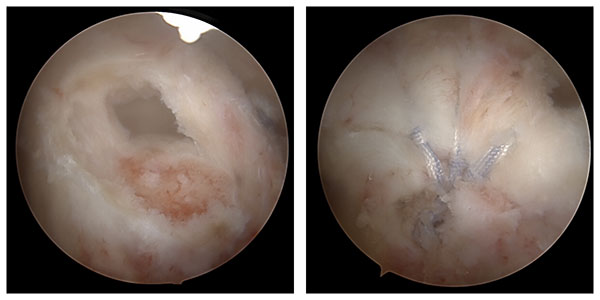
Credit: Arthroscopic images courtesy of Dr. Gabriella Ode.
Most repairs are performed arthroscopically through several small incisions. Anchors are placed into the humerus and sutures pass through the tendon to draw it back to its bony footprint. Additional work - biceps tenodesis, AC joint resection, acromioplasty - is added as indicated.
The two images above show what that means in practice. They are the same shoulder, before and after repair of a supraspinatus tear - the tendon at the top of the shoulder, and the one most commonly torn. On the left, it has separated from the bone and there is a visible gap. On the right, the same tendon has been brought back down to its footprint and secured.
The sutures themselves are not what holds the repair long term. They hold the tendon in position while the tissue heals back onto the bone over the following weeks and months. That biological healing is what ultimately holds, and it is the reason the early restrictions matter as much as they do - the construct is only as strong as the sutures until the tendon knits back down.
Anesthesia. Surgery is often performed under either moderate sedation or general anesthesia, combined with a nerve block. The block numbs the surgical extremity during the operation and for several hours afterwards, which substantially reduces the pain of the first night.
Time in the operating suite exceeds the operation itself. Anesthesia, positioning, and preparation happen before surgery starts; waking and transport to recovery happen after it finishes. Plan accordingly, and tell whoever is driving you home.
Most rotator cuff repairs are done as day surgery - you go home the same day. You will need someone to drive you and, realistically, someone around for the first day or two.
The Recovery Timeline
Recovery is long, and understanding that before committing matters. The restrictions in the early phase are not caution for its own sake - a repaired tendon has essentially no strength until biological healing occurs. Nearly all of the load that causes an early repair to fail happens during this window, which is why the restrictions are as specific as they are.
| Phase | What’s happening |
|---|---|
| Weeks 0 - 2 | Sling. Pain control. Elbow, wrist, and hand are free to use - typing, writing, holding a cup. No shoulder motion of your own. |
| Weeks 2 - 6 | Passive motion begins with your therapist. Still no active shoulder motion. Sling comes off at week 4 for a small tear; a larger repair weans through week 6 (below). |
| Weeks 6 - 12 | Active motion begins. Gradual return of everyday use. |
| Months 3 - 6 | Strengthening. Most of the functional gain happens here. |
| Months 6 - 12 | Continued improvement. Return to demanding activity. |
The first six weeks are the hardest part. Not because of pain - the pain settles reasonably quickly for most people - but because you cannot use the arm, and that is genuinely disruptive to daily life.
How I Use the Sling After a Cuff Repair
Rehabilitation is not one-size-fits-all - it depends on the size of the tear. I use two protocols, and the difference between them is real: a larger repair is under more tension and needs longer protection before it can be trusted.
For a small tear (under 3 cm):
- Weeks 0 to 4 - sling at all times, with three exceptions: your exercises, showering, and sitting in a chair where your arm can rest supported on an armrest.
- After week 4 - sling discontinued, with my go-ahead.
For a large or massive tear (3 cm or greater):
- Weeks 0 to 4 - sling at all times, with the same three exceptions.
- Weeks 4 to 6 - sling for sleep and any time you leave the house.
- After week 6 - sling discontinued, with my go-ahead.
The weaning phase for a larger repair - sling for sleep and outside the house - uses the same reasoning I give my shoulder replacement patients: at that stage the sling is there for protection in uncontrolled environments. When you’re asleep, you can’t control how your arm moves. When you’re outside the house, there are variables you don’t control either - an uneven sidewalk, someone bumping into you in a crowd. Those are the settings where I want the extra protection while a larger repair finishes the most vulnerable part of its healing.
Two restrictions are easy to misunderstand, so here they are plainly. There is no active shoulder motion in the early phase - meaning you do not lift the arm using your own shoulder muscles, even though it may feel possible. And there is no reaching behind your back. Both put direct tension across a repair that has essentially no strength yet.
Passive motion, guided by your therapist, typically begins around two weeks. If you have an abduction pillow, it usually comes off around week 3 for a small tear and week 4 for a larger one.
If you’ve been given a timeline by someone else, or read one online, it may not be the timeline that applies to your repair. Your protocol should be specific to what was actually found and fixed in your shoulder.
My written physical therapy protocols are all posted here: Post-Operative PT Protocols
These are the same documents I give your physical therapist. They’re written for clinicians and are more detailed than most patients need, but you’re welcome to read them.
Practical Questions to Ask
Using Your Hand and Elbow in the Early Weeks
This is the most useful thing to understand about the early weeks, and it is the part patients most often assume the opposite of.
The restriction is on shoulder motion, not on using your hand. Your elbow, wrist, and hand are not immobilized. Once the nerve block wears off, usually the day after surgery, you can take your arm out of the sling and type, write, hold your phone, use a fork, and hold a full cup of coffee in the operative hand.
That last one is the rule of thumb I give patients: you can hold the weight of a full coffee cup. It is a useful mental yardstick because it is specific - heavier than a phone, lighter than a grocery bag - and it covers most of what a hand does in a day.
What separates permitted from not permitted is where the movement comes from. Using your fingers, wrist, and elbow while your upper arm stays quietly at your side puts essentially no tension on the repair. Lifting or reaching with the shoulder - raising the arm away from your body, reaching forward or overhead, reaching behind your back - is what loads the tendon, and that is what the sling is there to prevent.
In practice this means the early weeks are less limiting than most people expect. Keeping the hand and elbow moving is also actively good for you: it reduces stiffness and swelling and helps you stay independent.
Driving. Not while you’re in the sling, and not while taking narcotic pain medication. For most patients that means four to six weeks. You need to be able to control the vehicle with both hands in an emergency.
Work. Desk work is often possible within one to two weeks, and typing is not the obstacle - as above, you can use the hand and wrist on the operative side from the day after surgery. The limiting factors early on are pain medication, fatigue, and the sling itself rather than the ability to work a keyboard. Work requiring lifting, overhead reaching, or real use of the shoulder generally means three to four months, sometimes longer. Discuss the specifics before surgery so you can plan leave.
Showering. Yes - the sling comes off for showering from the start. Let the arm hang at your side; don’t use it to wash or reach.
Sleep. Most patients sleep propped up on pillows or in a recliner for the first few weeks, then gradually return to lying flatter. Neither position is required. As long as you’re sleeping in your sling with your arm positioned appropriately, you’re safe.
Which shoulder, and living alone. If it’s your dominant arm, or if you live alone, plan more help for the first two weeks than you think you’ll need. The difficulty is not the hand - it is everything that needs a shoulder. Dressing, washing your hair, reaching a shelf, carrying anything of weight, and getting a coat on all become awkward with one arm effectively out of use.
Risks
Arthroscopic rotator cuff repair is a well-established operation and serious complications are uncommon. The relevant ones:
- Persistent pain. Some patients continue to have shoulder pain even after a technically successful repair. Pain around the shoulder is complicated and multifaceted, and several possible sources are not addressed by repairing the tendon - the neck, the biceps tendon, the AC joint, arthritis in the joint itself, and the mechanics of the shoulder blade among them. The risk is small, but it is never zero.
- Retear - the most common mode of structural failure, discussed above
- Stiffness - the most frequent complication, and the reason consistent early therapy matters
- Infection - uncommon in arthroscopic surgery, under 1%, but it can still occur
- Nerve injury - usually a temporary neuropraxia that resolves
- Blood clot and anesthetic complications - uncommon (under 1%), but they can still occur
When a Tear Can’t Be Repaired
Not every tear can be fixed. When a tendon has retracted far, the muscle has undergone fatty degeneration, or the tissue simply won’t hold sutures, repair is either not possible or unlikely to hold.
There are still options: continued non-operative management with a deltoid-focused program, superior capsular reconstruction, tendon transfer, or a subacromial balloon spacer.
Reverse shoulder arthroplasty is the option in two situations: when arthritis related to the rotator cuff tear has developed - cuff tear arthropathy - or in the case of a massive irreparable cuff tear. A reverse replacement does not depend on the rotator cuff to work, which is precisely why it succeeds where a repair cannot.
Which of these is appropriate depends on your age, your activity, whether arthritis is present, and what specifically is limiting you.
Frequently Asked Questions
How long is recovery from rotator cuff repair surgery?
A sling for four to six weeks, active motion beginning around six weeks, strengthening around three months, and meaningful recovery continuing to six months. Full recovery often takes nine to twelve months. It is a long rehabilitation and should be planned for realistically before committing to surgery.
How long do I have to wear a sling after rotator cuff surgery?
It depends on the size of the tear. For a small tear (under 3 cm), the sling is worn at all times for four weeks - except for exercises, showering, and sitting in a chair with your arm supported on an armrest - and is then discontinued. For a large or massive tear (3 cm or greater), the sling is worn at all times through week four, then for sleep and any time you leave the house through week six, and is then discontinued. That extra weaning phase for larger repairs is about protection in situations where you can’t control how your arm gets moved.
What’s the failure rate of rotator cuff repair?
Reported retear rates vary considerably across studies, commonly in the range of 15–30% for typical tears and higher for large or massive tears, smokers, patients with diabetes or poor tissue quality, and increasing age. Importantly, many patients with a structural retear still report good pain relief and satisfaction.
Does age affect whether a rotator cuff repair will heal?
Yes. Age is one of the strongest predictors of healing, alongside tear size, diabetes, and smoking. In a study of 1,600 consecutive arthroscopic repairs assessed by ultrasound, retear rates were 5% under age 50, 10% at 50–59, 15% at 60–69, 25% at 70–79, and 34% at 80 and over. The increase is gradual through the sixties and accelerates after 70. A meta-analysis of 38 studies found each additional year of age carried roughly a 5% increase in the odds of retear, meaning the risk approximately doubles between age 50 and age 70.
Am I too old for rotator cuff surgery?
Age alone is not a reason to rule out repair. A systematic review of patients over 70 undergoing arthroscopic rotator cuff repair found a mean retear rate of 21.9% alongside 95% patient satisfaction and meaningful functional improvement across every outcome measure. Both findings can be true because structural healing and how a shoulder feels are only loosely correlated - a repair that does not fully heal often still relieves pain and restores useful function. What age changes is the conversation: the realistic probability of complete healing should be discussed beforehand, weighed against what non-surgical management offers, and considered alongside whether a different operation might serve the goal better.
Why is healing less likely in older patients?
It reflects tissue biology and what tends to accompany it: an older tendon has less healing capacity, tendon quality at the time of repair is often poorer, there is usually more fatty degeneration of the muscle, tears tend to be larger by the time they are treated, and bone density at the site where the anchors must hold is lower.
Will a rotator cuff repair definitely take my pain away?
For most patients, pain relief is the most reliable benefit of the operation. But some patients continue to have shoulder pain afterwards. Pain around the shoulder is complicated, and several possible sources - the neck, the biceps tendon, the AC joint, arthritis in the joint itself, shoulder blade mechanics - are not addressed by repairing the tendon. This is why careful evaluation beforehand matters. The risk of persistent pain is small, but it is never zero.
How should I sleep after rotator cuff surgery?
Most patients sleep either in bed propped up on pillows or in a recliner, and gradually return to lying flatter as pain settles. Neither is required - as long as you’re sleeping in your sling with your arm positioned appropriately, you are safe. There’s no single correct position you have to achieve. Lying flat simply isn’t very comfortable in the first weeks after surgery, so most people end up propped up because it feels better. Sleep disruption is the most commonly reported frustration in the early weeks, and it is temporary.
When can I drive after rotator cuff surgery?
Not while you’re wearing the sling and not while taking narcotic pain medication - for most patients that means four to six weeks. You need to be able to control the vehicle with both hands in an emergency.
When can I go back to work?
Desk work is often possible within one to two weeks. Typing is not the barrier people expect it to be - you can use the hand and wrist on the operative side once the nerve block wears off, usually the day after surgery. The limiting factors early on are pain medication, fatigue, and the sling rather than the keyboard. Work involving lifting, overhead reaching, or real use of the shoulder generally means three to four months, sometimes longer. Discuss your specific job before surgery so you can plan leave properly.
Can I use my hand after rotator cuff surgery?
Yes. The restriction is on shoulder motion, not on using your hand. Your elbow, wrist, and hand are not immobilized, and once the nerve block wears off - usually the day after surgery - you can take the arm out of the sling to type, write, hold your phone, eat, and hold a full cup of coffee in the operative hand. A useful rule of thumb is that you can hold the weight of a full coffee cup. What is not permitted is movement that comes from the shoulder: lifting the arm away from your body, reaching forward or overhead, or reaching behind your back. Keeping the hand and elbow moving also reduces stiffness and swelling.
Is rotator cuff repair done as day surgery?
Usually yes - most patients go home the same day. You’ll need someone to drive you home, and realistically someone available for the first day or two while you adjust to using one arm.
Does smoking affect rotator cuff healing?
Yes, and it’s one of the few risk factors you can change. Smoking is consistently associated with higher retear rates and poorer tendon healing. Stopping before surgery is one of the most useful things a patient can do to improve their own result.
What happens if my repair retears?
Not every retear needs another operation. Many patients with a structural retear still have good pain relief and function, and no further surgery is warranted. When symptoms do return significantly, options include revision repair, tendon transfer, or superior capsular reconstruction. Reverse shoulder arthroplasty is considered when arthritis related to the rotator cuff tear has developed, or in the case of a massive irreparable tear. Which applies depends on your age, tissue quality, and what is limiting you.
Can I have surgery if I’ve had a cortisone injection recently?
Timing matters, because injection shortly before surgery may increase infection risk. There is no universally agreed interval; Dr. Ode’s own preference is that roughly three months have elapsed, which is her recommendation rather than a fixed rule - the appropriate interval depends in part on where the injection was placed, and other surgeons may advise differently. Tell your surgeon both the date and the location of your most recent injection, since neither detail reliably appears in a referral. In most cases this is a scheduling consideration rather than a barrier. More on injections and non-surgical treatment.
Considering rotator cuff surgery, or trying to decide whether you need it?
Dr. Gabriella Ode is a fellowship-trained shoulder and sports medicine surgeon at the HSS Sports Medicine Institute, with offices in Manhattan and Brooklyn. She provides candid guidance on when rotator cuff surgery is warranted - and when it isn’t. Request an appointment or request a remote second opinion.
Financial disclosure. Dr. Ode is a paid consultant for Advita Ortho and ConMed, manufacturers of orthopaedic implants and surgical instrumentation. These relationships are reported publicly through the CMS Open Payments database. She receives no compensation for this website, and no compensation is tied to any individual patient’s treatment decision. Her complete financial disclosures are available here.
This article is for general education and is not a substitute for individual medical advice. Please consult a physician about your specific condition.