- Shoulder Replacement
- Total Shoulder Replacement
- Revision Shoulder Replacement
- Computer Navigation for Shoulder Replacement
- GPS-guided Shoulder Replacement
- Outpatient Shoulder Replacement
Reverse Shoulder Replacement Surgeon in Brooklyn, New York
Individuals with rotator cuff tear arthropathy (occurrence of shoulder arthritis and rotator cuff tear), a fully torn rotator cuff that is difficult to repair or prior failed shoulder replacement are candidates for reverse shoulder replacement. Gabriella Ode, MD, Orthopedic Surgeon, Sports Medicine Specialist provides diagnosis and individualized nonoperative and operative treatments for the shoulder including reverse shoulder replacement in Brooklyn, New York. Gabriella Ode, MD, Orthopedic Surgeon, Sports Medicine Specialist also provides the highest level of care during and after surgery. Contact Gabriella Ode, MD, Orthopedic Surgeon, Sports Medicine Specialist’s office for an appointment today!

Reverse Shoulder Replacement: How It Works and Who It’s For
A reverse Total Shoulder Replacement switches the positions of the ball and socket in the shoulder joint. A metal ball is fixed to the shoulder blade, and a plastic socket is fixed to the top of the arm bone - the opposite of normal anatomy. That single change allows the deltoid, the large muscle over the outside of your shoulder, to lift the arm on its own, without help from the rotator cuff.
That is the entire idea, and it solved a problem that had no good answer for most of the twentieth century: what to do for a painful shoulder in a patient whose rotator cuff no longer works. The design was developed in Europe in the 1980s and approved for use in the United States in 2003. It has since become one of the most-performed shoulder operations in the country.
Why reversing the joint works
In a normal shoulder, the rotator cuff has an unglamorous but essential job: it holds the ball centered in the shallow socket so the deltoid can lift the arm. Without that stabilizing force, contracting the deltoid simply drags the humeral head upward instead of raising the arm. This is why some patients with massive rotator cuff tears cannot lift the arm at all despite having a strong deltoid - a condition called pseudoparalysis.
Reversing the joint changes the mechanics in two ways. It moves the center of rotation inward and downward, which lengthens the deltoid’s lever arm and gives it far more mechanical advantage. And it creates a deep, constrained, inherently stable joint that does not need the rotator cuff to stay centered.
The result is a shoulder that can be lifted overhead using the deltoid alone.
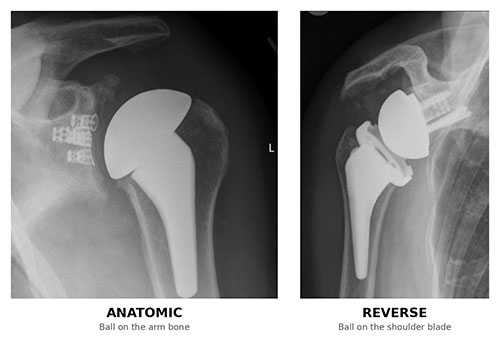
Caption: Anatomic (left) and reverse (right) Total Shoulder Replacement, side by side. In the anatomic replacement the ball sits on the arm bone and the socket on the shoulder blade, as in a normal shoulder. In the reverse, those positions are switched - the ball is fixed to the shoulder blade and the socket to the top of the arm bone.
Vendor note: shared asset - used on the Shoulder arthritis, Total Shoulder Replacement, Reverse Shoulder Replacement, and Computer-Navigated Shoulder Replacement pages. One copy in the media library, referenced from all four.
The difference is easiest to see side by side. Look at where the round ball sits in each image: on the left it is on the arm bone, where it belongs in a normal shoulder. On the right it has been moved onto the shoulder blade, and the socket has been moved onto the arm.
Who needs a reverse replacement?
A reverse replacement is indicated when the shoulder is painful or non-functional and the rotator cuff cannot be relied upon. The specific situations:
Cuff tear arthropathy - the classic indication. A long-standing massive rotator cuff tear has allowed the humeral head to migrate upward, producing a distinct pattern of arthritis. This is the problem the reverse replacement was invented to solve.
Massive irreparable rotator cuff tear with loss of function - pseudoparalysis, with or without much arthritis.
Arthritis with severe glenoid bone loss or deformity - where there isn’t enough healthy bone to reliably support an anatomic socket component.
Failed prior rotator cuff surgery with persistent weakness and pain.
Complex proximal humerus fractures in older patients, where the tuberosities that anchor the rotator cuff are unlikely to heal reliably.
Revision of a failed anatomic shoulder replacement, particularly when the rotator cuff has torn since the original surgery.
Inflammatory arthritis with rotator cuff destruction.
If your rotator cuff is intact and functioning, an anatomic total shoulder replacement is usually the better operation - it typically produces more natural rotation. Reverse is not a “better” replacement; it is the right answer to a different problem.
What a reverse replacement does well - and what it doesn’t
Patients deserve an honest account of both, because unrealistic expectations are the most common reason a technically excellent reverse replacement leaves someone disappointed.
What it reliably delivers:
- Pain relief. This is the strongest and most consistent benefit. The great majority of patients report substantial relief of arthritis pain, including night pain.
- Restored overhead elevation. Patients who could not lift the arm can often raise it above shoulder height again.
- The design is inherently stable.
- Independence in daily activities - dressing, grooming, reaching a cabinet, driving.
What it does less well:
- External rotation - turning the arm outward - often improves less than elevation does, particularly when the posterior rotator cuff (teres minor) is also gone. Some patients notice difficulty reaching out to the side or behind them.
- Internal rotation. Reaching behind the back is the motion most commonly still limited afterward. This affects tucking in a shirt, fastening a bra, and personal hygiene, and it is worth discussing candidly before surgery rather than discovering after.
- Heavy lifting. Repetitive heavy lifting should be avoided long-term to protect the implant.
Implant design and surgical technique have improved rotation outcomes considerably in recent years, and tendon transfers can be added in selected cases. But a reverse shoulder is not a normal shoulder, and the patients who do best are the ones who understood that going in.
Precision matters even more here
The baseplate - the component fixed to the shoulder blade - carries very high mechanical loads and must be anchored into a limited amount of bone, often in a shoulder where that bone has already been eroded by arthritis or by superior migration of the humeral head. Baseplate position determines stability, range of motion, the risk of the implant notching against the bone below it, and the long-term security of fixation. Screw trajectory matters too: the screws need to find dense bone within the glenoid vault and the body of the scapula.
I perform reverse shoulder arthroplasty using computer navigation on the AdvitaGPS platform. A preoperative CT scan builds a three-dimensional model of your scapula, the baseplate position and screw trajectories are planned in advance on that model, and during surgery the navigation system confirms in real time that the plan is being executed - including live feedback on screw trajectory, which is not something the eye can judge reliably.
Published data on the platform reports 98% of more than 16,000 navigated cases completed as planned, with placement verified within approximately 2 mm and 2 degrees, and a very low complication rate attributable to the navigation itself.
By number of navigated cases performed, I am among the top 5% of surgeons worldwide.
Full detail: Computer-Navigated Shoulder Replacement · Manufacturer information: AdvitaGPS Shoulder
Recovery
Recovery from a reverse replacement is often more straightforward than from an anatomic replacement, because there is no rotator cuff repair that must heal before active motion can begin. Many patients begin active-assisted motion earlier.
How I use the sling: 2 to 4 weeks
The sling protocol after a reverse replacement follows the same pattern I use for an anatomic total shoulder replacement, on a shorter timeline.
Weeks 0 to 2 - sling on, with two specific exceptions.
Wear the sling whenever you are walking around your home, whenever you are sleeping, and any time you leave the house.
You may take it off for two things:
- Showering
- Sitting. When you are awake and seated in a chair where your arm and elbow can rest supported on an armrest, the sling can come off. This begins once the nerve block has worn off and sensation and movement have returned to your arm.
If you get up from that chair to walk anywhere - even a few steps - put the sling back on.
Weeks 2 to 4 - sling for sleep and for leaving the house.
You no longer need the sling to walk around your own home. You should still wear it while sleeping and any time you go out.
The reasoning I give patients: the sling in this phase is for protection in uncontrolled environments. When you’re asleep, you can’t control how your arm moves. When you’re outside the house, there are variables you don’t control either - an uneven sidewalk, someone bumping into you in a crowd. Those are the settings where I want the extra protection.
End of week 4 - the sling is discontinued entirely.
The timeline is extended - often to six weeks - if the reverse replacement is a revision procedure or was performed for a fracture.
My full written physical therapy protocol for reverse shoulder replacement is available here: Reverse Total Shoulder Arthroplasty PT Protocol (PDF)
This is the same document I give your physical therapist. You are welcome to read it, though it is written for clinicians and is more detailed than most patients need.
Alongside the sling protocol:
Weeks 0 - 2. Elbow, wrist, and hand motion from day one.
On sleeping. Most patients sleep either in bed propped up on pillows or in a recliner. That’s usual - but it isn’t required. As long as you are sleeping in your sling with your arm positioned appropriately, you are safe. There is no single correct position you have to achieve.
What is true is that lying flat is not very comfortable for the first few weeks after surgery, so most people end up propped up simply because it feels better. Finding a position that works for you may take some experimenting, and that’s normal. Sleep is the most commonly reported frustration in the early weeks, and it does settle.
Weeks 2 - 6. Progressive passive and active-assisted motion. Many patients begin light active elevation within this window. The important early restriction is avoiding the combined position of extension, adduction, and internal rotation - reaching behind your back - which is the position of greatest dislocation risk early on.
Weeks 6 - 12. Active motion and light strengthening progress. Deltoid strengthening becomes the focus, since the deltoid is now doing the work the rotator cuff used to do.
Months 3 - 6. Functional strengthening and return to most activities. Golf and swimming are typically discussed in this window - including which strokes are reasonable for you.
Months 6 - 12. Continued improvement in strength and endurance. Rotation, if it is going to improve, tends to do so slowly across the first year.
Long-term. Walking, hiking, cycling, and golf are generally well tolerated. Repetitive heavy lifting should be avoided.
Repetitive heavy lifting and repetitive rotational loading carry a real risk of wearing the implant out early, and that risk accumulates over years rather than showing up in any single session. The category is broader than most patients expect: heavy weight training and repetitive overhead lifting, but also singles tennis and swimming strokes such as freestyle, backstroke, and butterfly, all of which load the shoulder through repeated rotation under force. Swimming is often described as universally shoulder-friendly, which isn’t quite right after a replacement - the stroke matters.
Being cleared to return to an activity is also not the same as being able to do it. Published return-to-sport rates after shoulder replacement are around 80% across most sports, which is encouraging - but it means some patients don’t get back to their sport even after a successful operation and full clearance.
How long does it last?
Published survivorship for reverse total shoulder replacement is approximately 99% at two years, 91 - 98% at five years, and around 88 - 90% at ten years. One long-term series using a trabecular metal implant reported 94.7% survival at five years and 90.5% at ten.
Age at surgery matters substantially. In one registry analysis, ten-year survival was 75.7% in patients under 60, compared with 88.8% for ages 60 - 69, 91.3% for ages 70 - 79, and 94.3% for those over 80. This is the central reason a reverse replacement in a patient in their fifties requires a much more careful discussion - not that it can’t be done, but that the probability of needing a revision in their lifetime is meaningfully higher.
Encouragingly, clinical outcomes in ten-year studies remain favorable even when radiographic changes accumulate.
Risks
Persistent pain after surgery. This deserves to be stated first, because it is the outcome patients least expect and the one that matters most to them.
Some patients continue to have shoulder pain even after a technically successful replacement. Pain around the shoulder is complicated and multifaceted, and there are a number of possible sources that are not fixed simply by replacing the joint - the neck, the biceps tendon, the AC joint, and the mechanics of the shoulder blade among them. A replacement addresses the arthritic joint and the mechanics of a shoulder without a working rotator cuff. It does not address everything that can hurt in that region.
This is part of why a careful evaluation before surgery matters so much: the goal is to establish, as confidently as possible, that the joint really is the source of your pain.
The risk of persistent pain is very small. It is not zero. Any surgeon who tells you otherwise is overpromising.
Other risks:
- Instability or dislocation - more relevant here than in anatomic replacement, though modern designs have reduced it considerably
- Infection - around 1%, with a somewhat higher rate in revision settings
- Acromial or scapular spine stress fracture - a recognized complication specific to reverse replacement, caused by the increased deltoid tension the design creates
- Scapular notching - the humeral component contacting the scapula below the glenoid in adduction; navigation and modern implant positioning have reduced its incidence
- Nerve injury - usually a temporary neuropraxia
- Baseplate loosening - uncommon, but a reason positioning matters
- Periprosthetic fracture, blood clot, anesthetic complications - uncommon (under 1%), but they can still occur
Frequently Asked Questions
Why is it called a “reverse” shoulder replacement?
Because the normal anatomy is reversed. In a healthy shoulder, the ball is on the arm bone and the socket on the shoulder blade. In a reverse replacement, a metal ball is attached to the shoulder blade and a plastic socket to the arm bone. This lets the deltoid muscle lift the arm without needing a functioning rotator cuff.
Will I be able to lift my arm overhead after a reverse shoulder replacement?
Most patients regain the ability to lift the arm to or above shoulder height, and many who could not raise the arm at all beforehand regain functional overhead reach. Elevation improves more predictably than rotation.
Will a reverse shoulder replacement definitely take my pain away?
For most patients, pain relief is the most reliable and consistent benefit of the operation. But some patients continue to have shoulder pain afterwards. Pain around the shoulder is complicated, and several possible sources - the neck, the biceps tendon, the AC joint, shoulder blade mechanics - are not addressed by replacing the joint itself. This is why a careful evaluation beforehand matters. The risk of persistent pain is small, but it is never zero.
Can I reach behind my back after a reverse shoulder replacement?
This is the motion most commonly still limited. Many patients regain enough internal rotation for daily tasks, but reaching high behind the back is often permanently restricted. It’s the single most important expectation to discuss honestly before surgery.
Will I be able to return to my sport after a reverse shoulder replacement?
Published return-to-sport rates after shoulder replacement are around 80% across most sports, so most patients do get back. But clearance to return isn’t the same as returning - some patients don’t, even after a successful operation, because comfort, strength, confidence, and endurance all have to come together. The activities warranting most caution long-term are those with repetitive heavy lifting or repetitive rotational loading, which drive implant wear: heavy weight training, repetitive overhead lifting, singles tennis, and swimming strokes such as freestyle, backstroke, and butterfly.
Is there a weight limit after a reverse shoulder replacement?
I don’t give patients a specific number, because there isn’t a well-established one. You will see figures quoted - ten pounds, fifteen pounds - but the evidence behind any particular threshold is thin. What is clear is the principle: repetitive heavy lifting should be avoided long-term, because cumulative load is what wears an implant out. The distinction that matters is repetition rather than a single lift. Occasionally carrying something heavy is a different proposition from lifting heavy weights several times a week for years.
Is a reverse shoulder replacement worse than a regular one?
Neither is better in the abstract - they solve different problems. If your rotator cuff works, an anatomic replacement generally restores more natural rotation. If your rotator cuff doesn’t work, an anatomic replacement will fail, and a reverse replacement is the operation that reliably relieves pain and restores function.
Can a reverse shoulder replacement be redone if it wears out?
Yes. Revision reverse shoulder arthroplasty is performed, though it is more complex than the original operation, and outcomes depend heavily on remaining bone stock and soft tissue quality. Revision shoulder arthroplasty is an area of specific focus in my practice.
How long do I have to wear a sling after a reverse shoulder replacement?
In my practice, two to four weeks. For the first two weeks the sling is worn for walking around the house, for sleeping, and any time you leave home - but it can come off for showering and while you’re seated in a chair with your arm supported on an armrest. From two to four weeks you no longer need it inside your own home, but you should still wear it for sleep and when you go out, because those are the situations where you can’t fully control how your arm gets moved. At the end of the fourth week it’s discontinued. This is a shorter timeline than after an anatomic replacement, where I use four to six weeks.
How should I sleep after a shoulder replacement?
Most patients sleep either in bed propped up on pillows or in a recliner, and gradually return to lying flatter as pain settles. Neither is required - as long as you’re sleeping in your sling with your arm positioned appropriately, you are safe. There’s no single correct position you have to achieve. Lying flat simply isn’t very comfortable in the first weeks after surgery, so most people end up propped up because it feels better. Finding what works for you may take some experimenting. Sleep disruption is the most commonly reported frustration in the early weeks, and it is temporary.
Considering a reverse shoulder replacement?
Dr. Gabriella Ode is a fellowship-trained shoulder surgeon at the HSS Sports Medicine Institute and Associate Professor of Orthopaedic Surgery at Weill Cornell Medical College, with advanced expertise in primary and revision shoulder arthroplasty and computer-navigated technique. Request an appointment or request a remote second opinion.
Financial disclosure.
Dr. Ode is a paid consultant for Advita Ortho and ConMed, manufacturers of orthopaedic implants and surgical instrumentation. These relationships are reported publicly through the CMS Open Payments database. She receives no compensation for this website, and no compensation is tied to any individual patient’s treatment decision. Her complete financial disclosures are available here.
This article is for general education and is not a substitute for individual medical advice. Please consult a physician about your specific condition.

If you would like additional information on the treatment of shoulder conditions or to learn more about reverse shoulder replacement, please contact Gabriella Ode, MD, Orthopedic Surgeon, Sports Medicine Specialist, serving the communities of Brooklyn, New York.