Treating a Rotator Cuff Tear Without Surgery
Non-surgical treatment has an important role in the management of rotator cuff tears, and for many patients it succeeds. It is not, however, the appropriate choice for every patient. Rotator cuff tears differ considerably from one another, and the decision between surgical and non-surgical management is an individual one that depends on the characteristics of the tear, the condition of the shoulder, and the needs of the patient.
The purpose of this page is to describe what non-surgical treatment involves, to summarize the evidence supporting it, and to outline how the decision between therapy and surgery should be approached. It is not intended to discourage surgery. It is intended to ensure that whichever course you take, you take it with a clear understanding of the alternative.
(For background, see degenerative rotator cuff tears: causes and diagnosis. For the operation itself, see rotator cuff repair surgery.)
The Spectrum of Rotator Cuff Disease
“Rotator cuff problem” covers considerably more than a torn tendon, and the distinction matters here, because several of the conditions grouped under that heading respond well to non-surgical treatment.
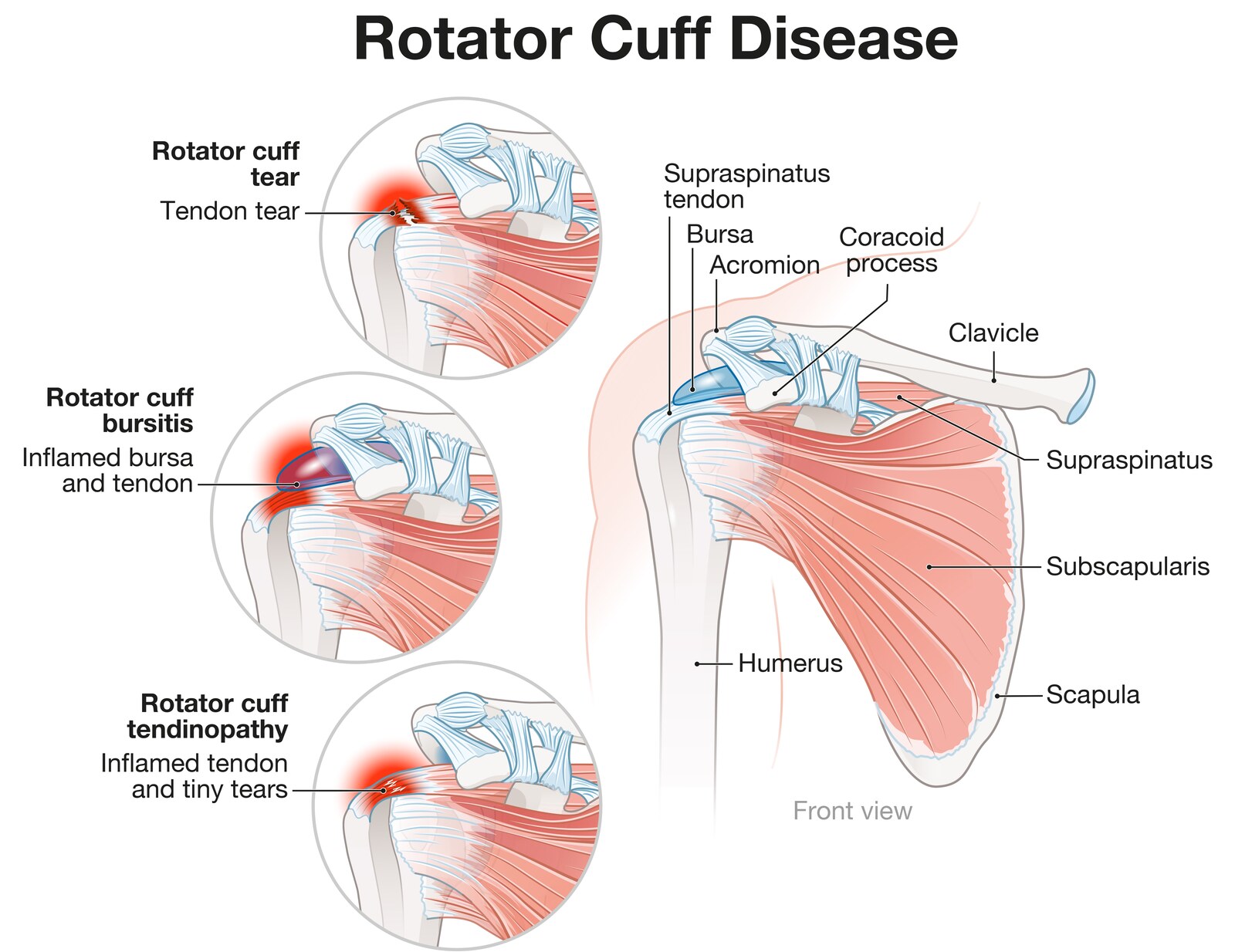
Caption: Three different problems that produce shoulder pain in the same region. Tendinopathy (bottom left) is degenerative change within the substance of the tendon - the collagen becomes disorganized and the tissue is structurally weakened, without a defect passing through it. Bursitis (middle left) is inflammation and thickening of the subacromial bursa, the thin gliding layer between the tendon and the bone above it. A rotator cuff tear (top left) is a defect through the tendon itself. The larger illustration shows the normal relationship between the supraspinatus tendon, the bursa, and the acromion above them.
Two of these terms need defining carefully, because both are commonly described inaccurately.
Tendinopathy is degeneration, not simply inflammation. The older term “tendinitis” implies an inflamed tendon, and that turns out to be a poor description of what is actually happening. What is found in these tendons is degenerative change within the tendon substance itself - collagen fibers lose their normal parallel organization, the cellular makeup of the tissue changes, and the tendon becomes structurally weaker than it should be. It is a problem of tissue quality rather than of inflammation, which is why anti-inflammatory treatment alone tends to help the symptoms without changing the underlying condition, and why loading the tendon progressively through a therapy program is the treatment that actually addresses it.
The bursa is not a fluid-filled sac in a healthy shoulder. It is more accurately described as a thin gliding layer - a potential space lined with synovium, containing barely more than a film of fluid - that sits between the rotator cuff tendon and the acromion above it, allowing the two to move against each other smoothly. Bursitis is what happens when that layer becomes inflamed and thickened. The space it occupies is tight to begin with, so a bursa that thickens has nowhere to expand into, and that is a significant part of why it hurts to reach overhead.
Neither of these has a structural defect to repair, which is why surgery has correspondingly little to offer them and non-surgical treatment is the mainstay. A tear is a different matter, and is the situation this page mainly addresses.
In practice the three coexist far more often than they occur in isolation. A degenerative tear almost always sits in a tendon that was already degenerating, and usually with some degree of bursal inflammation alongside it. Part of what a well-constructed treatment plan does is settle the inflammatory component enough that the shoulder can tolerate the rehabilitation that addresses the rest.
Why a Torn Tendon Can Still Function Well
Patients are frequently puzzled by the proposition that a torn tendon can be treated without repairing the tear. The concept that resolves this is straightforward:
The tendon does not need to be structurally intact for the shoulder to function well.
The rotator cuff possesses a degree of redundancy - four tendons share the work of stabilizing and moving the joint. When the remaining tendons and the surrounding musculature are strengthened sufficiently to keep the humeral head centered within the socket, the shoulder can function comfortably despite a persistent structural tear.
Many patients with degenerative tears achieve precisely this result. The tear remains. The symptoms resolve.
Population-level data support this observation. In 2026, investigators reported MRI findings from both shoulders in 602 randomly selected adults aged 41 to 76 drawn from the general Finnish population. Rotator cuff abnormalities were present in 96% of shoulders with no symptoms whatsoever, and 6.5% of pain-free shoulders harbored a full-thickness tear. A substantial proportion of the population lives comfortably with a torn rotator cuff, which demonstrates as clearly as any dataset can that a tear and a clinical problem are not equivalent.
(Ibounig T, et al. JAMA Intern Med. 2026;186(4):406–414. Discussed in greater detail on the rotator cuff tears page.)
This distinction - that treatment addresses symptoms rather than images - is the foundation of non-surgical management. It is also why an MRI report alone does not determine treatment: the decision is governed by your pain, your function, and your goals, not by the appearance of the scan.
What the Evidence Establishes, and What It Does Not
This question has been studied rigorously.
The MOON Shoulder Group followed 452 patients with atraumatic full-thickness rotator cuff tears through a structured physical therapy program, with reassessment at 6 and 12 weeks. Fewer than a quarter proceeded to surgery. At ten years, physical therapy remained successful in more than 70% of patients, and among those who never underwent surgery, outcome scores did not decline over the decade.
This is a substantial finding, and it is the reason I offer a trial of therapy to most patients with this type of tear.
The inclusion criteria, however, define the boundaries of what the study can tell us. These were atraumatic, degenerative tears - tendons that wore through gradually. The findings do not extend to acute traumatic tears, to younger patients with healthy tissue, to tears producing significant weakness, or to patients whose function is already declining. In those circumstances the evidence points in a different direction, and so do my recommendations.
(Kuhn et al., J Shoulder Elbow Surg 2013;22:1371–1379; Kuhn et al., J Bone Joint Surg Am 2024;106:1563–1572)
Weighing Surgical Against Non-Surgical Management
This is the discussion that determines your treatment, and the purpose of this section is to set out what it rests on.
Surgical repair confers real and well-documented benefits: reliable pain relief in most patients, restoration of strength when the tendon heals, and, in appropriately selected patients, prevention of a tear enlarging into one that can no longer be repaired. These benefits must be weighed against the risks of the operation and against a recovery period of six to twelve months. The surgical page presents both sides in detail, and reading it is useful even if you hope to avoid an operation.
The essential point is that this decision cannot be made from a diagnosis alone. Two patients whose MRI reports read identically may reasonably reach opposite conclusions. The factors that influence the decision include:
The characteristics of the tear - whether it is partial or full-thickness, its size, the degree of tendon retraction, whether the muscle has undergone fatty change, and the quality of the remaining tissue. Some tears are highly amenable to repair and others are not, and that distinction carries considerable weight.
The mechanism of injury - a tendon that failed during a fall behaves differently from one that wore through over a decade, and the treatment rationale differs accordingly.
The functional deficit - pain in isolation is one clinical picture. Demonstrable weakness, or an inability to elevate the arm overhead, is another. Function that is deteriorating rather than stable is another still.
Your functional demands - your occupation, athletic activities, age, hand dominance, and the specific tasks you are unable to perform. A retired patient with tolerable pain and a working carpenter with an identical MRI are not in comparable positions.
Your age - this is a genuine biological factor rather than a proxy for anything else. The likelihood that a repaired tendon heals declines with age, gradually through the sixties and more steeply after 70, where retear rates in published series reach 25% or higher. This does not make repair inadvisable in an older patient - satisfaction after repair over 70 is high, and many patients whose repair does not fully heal still do well - but it belongs in the discussion. The surgical page sets out the figures.
Your general health - diabetes, smoking, and tissue quality each influence the likelihood that a repair will heal, and they belong in the calculation before surgery rather than after it.
Your prior treatment and its results.
And your own priorities. Some patients prefer to exhaust every alternative before considering an operation. Others, given identical information, would rather address the problem definitively and proceed with recovery. Both positions are reasonable. My responsibility is to ensure that you have accurate information regarding pain, function, and quality of life on both sides of the decision - not to make the decision on your behalf.
None of this renders non-surgical treatment a lesser option. It establishes it as one of two reasonable options, selected deliberately.
The Appropriate Duration of a Therapy Trial
Six to twelve weeks. This figure is not arbitrary; it derives from the same body of research.
Within the MOON cohort, patients who ultimately elected surgery generally reached that decision between 6 and 12 weeks. Few decided later. This provides a practical answer: if therapy is going to succeed, you will usually know within approximately three months.
The plan I establish with patients follows from this. Commit fully for six weeks, then reassess. If you are clearly improving, continue. If you have improved but not sufficiently, continue and reassess again. If nothing has changed, that is meaningful clinical information, and we discuss surgery.
A Finding That Needs Context
In the ten-year data, the factor most strongly predictive of early surgery was a low expectation that physical therapy would succeed. Not tear size. Not age. Not the severity of the MRI findings. The strongest predictor was entering therapy without confidence in it.
This finding is easily misread, and I want to address that directly. It does not indicate that patients who underwent surgery failed to believe sufficiently. Many patients require an operation, and electing one early is frequently the correct decision. But the association is real and the mechanism is intuitive: a patient who begins a three-month program convinced of its futility is less likely to perform the home exercises, less likely to persist through the weeks in which little appears to change, and more likely to discontinue before the program has had an opportunity to work.
The practical implication is that a trial of therapy, once agreed upon, should be set up to succeed. A course that ends before it has been given a fair opportunity - whether because expectations were low, because pain made the exercises intolerable, or because the program was not the right one - leaves us without reliable information about whether therapy would have worked, which means it also leaves the surgical decision less well informed than it should be. Each of those obstacles has a different remedy, and each should be raised rather than absorbed.
The commitment required is not trivial, and I would not represent it otherwise. A proper course of therapy demands time and sustained effort - attending appointments, performing the home program, and continuing past the point at which progress feels imperceptible. For an appropriate tear, the return on that investment is frequently excellent. If you would prefer not to undertake it, say so. That belongs in the decision rather than being something to talk you out of.
The Components of a Proper Program
Physical therapy is the foundation of non-surgical management, and what the therapy targets is consequential.
An effective program addresses:
- The intact remaining cuff tendons - strengthening what continues to function so that it can compensate for what does not.
- The deltoid, which assumes a greater share of the load when the cuff is compromised.
- The scapular stabilizers. This is the component most commonly neglected. The shoulder blade is the platform from which the entire arm moves, and a program that disregards it operates at a distinct disadvantage.
- Posterior capsule mobility, where tightness is a contributing factor.
- The kinetic chain - trunk and hip strength meaningfully influence shoulder mechanics, particularly in patients who remain active overhead.
A meaningful course of therapy consists of weeks of consistent work, the majority of it performed at home between appointments. The home program produces most of the result; the supervised visits provide progression and correction.
If therapy is too painful to continue, that is a reason to come back sooner rather than to stop. Pain that prevents you from performing the exercises is a problem we can usually address - by modifying the program, adjusting how it is paced, reconsidering anti-inflammatory medication, or, where appropriate, offering an injection to create a window in which the exercises become possible. A course of therapy that ends early because it hurt too much has not told us whether therapy would have worked; it has told us that the pain needed managing first. Please tell me if that is what is happening, rather than waiting until your next scheduled appointment.
The shoulder conditioning program I give patients is posted here: Shoulder Conditioning Program (PDF)
It is the AAOS program, and it is a reasonable starting point for the home component of your therapy. It does not replace a program prescribed for your specific shoulder - your therapist should adapt it to what was actually found on your imaging and examination - but it gives you something structured to work from between appointments.
Activity Modification Rather Than Rest
One distinction matters here: modifying activity is not equivalent to resting the arm.
Prolonged rest is counterproductive. It produces stiffness and deconditioning, and results in a shoulder that tolerates the tear less well than it did previously. The more effective approach is to identify the two or three specific movements that reliably provoke pain - typically heavy overhead reaching or pressing - and substitute alternatives, while remaining active in all other respects.
Most patients are able to continue lower-body training, cardiovascular exercise, and a considerable proportion of upper-body work. A well-conditioned shoulder tolerates a tear substantially better than a deconditioned one.
Swimmers are a useful illustration of the principle. Rotator cuff tendinitis is the most common shoulder complaint in the sport, and conditioning can usually be maintained through a painful period - kicking with the arms at the side, then progressing through lower-stress strokes with shorter repetitions before returning to a normal routine. Returning to high-intensity swimming too early tends to produce a cycle of recurrence. I discussed this in an article for U.S. Masters Swimming.
Anti-Inflammatory Medication
Over-the-counter anti-inflammatory medications can meaningfully reduce pain, particularly during the early weeks when discomfort interferes with participation in therapy.
They carry real risks with prolonged use - gastrointestinal, renal, and cardiovascular - and should therefore be discussed with your physician rather than continued indefinitely by default. Their useful role is short-term: sufficient relief to permit engagement with the program.
Corticosteroid Injection
A corticosteroid injection can be a valuable adjunct, and it can also be overused. Both statements are accurate, and the distinction lies in how it is employed.
Where it is beneficial: interrupting a pain cycle that is preventing effective therapy. When pain is severe enough to preclude performing the exercises, an injection can create the interval during which meaningful treatment becomes possible. Used in this manner - as a means of enabling therapy rather than as the treatment itself - it is a sound clinical tool.
Where greater caution is warranted:
- Repeated injections into the cuff have been associated with tendon deterioration. This is not a treatment to which one should return indefinitely.
- Injection shortly before surgery may elevate infection risk. This is the reason timing matters once repair is under consideration.
An injection that provides three months of comfort during which strength is rebuilt has served its purpose. An injection that becomes the treatment plan has not.
Timing Between an Injection and Surgery
If surgery is a realistic possibility, plan the interval between your last injection and the operation rather than leaving it to chance.
There is no universally agreed number here, so I will tell you mine. My own preference is that roughly three months have elapsed between an injection and surgery. That is my recommendation rather than a fixed rule, and I weigh it case by case - the appropriate interval depends in part on where the injection was placed, and it has to be balanced against how much your symptoms warrant treatment in the meantime. Another surgeon may advise a different interval, and that is a reasonable difference of practice rather than a disagreement about the underlying principle.
The practical implications for you are straightforward:
- Tell any surgeon the date of your most recent injection, and where it was given. Both details matter, and neither reliably appears in the notes that accompany a referral.
- If surgery is already being contemplated, say so before accepting an injection. It may still be the right decision - but it is a decision better made with the surgical timeline in view than discovered afterwards.
This is not a reason to decline an injection that would genuinely help you. It is a reason to keep the two conversations connected.
The Limitations of Non-Surgical Treatment
Defining the limits of this approach is as important as describing its benefits.
- It will not heal the tear. A full-thickness tear does not reattach to bone without surgery. The objective is a shoulder that functions well despite the tear, not a shoulder that is structurally normal.
- It does not reliably or predictably restore full strength lost to a large tear. Some patients regain a considerable amount through compensation by the remaining musculature, but the result is variable. Where weakness rather than pain is the predominant complaint, therapy has less to offer, and repair merits serious consideration.
- It is not universally effective. Approximately a quarter to a third of patients in the published research proceeded to surgery. That is a meaningful proportion, and there is nothing untoward about being among them.
- It is less often the initial recommendation for certain tears, though circumstances vary. Acute traumatic tears in younger patients, tears producing significant functional loss, and repairable tears in patients whose function is deteriorating are situations in which I would generally suggest discussing surgery rather than deferring it - when the other conditions favor an operation. Those conditions are not always present. Medical comorbidities, the timing of other treatment, and a patient’s own priorities may all make non-surgical management the sensible course even for a tear that would otherwise be repaired, and there is nothing deficient about that path. What matters is that it was chosen with the alternative understood. The evidence summarized above pertains specifically to degenerative, atraumatic tears in patients whose principal complaint is pain.
- Delay is not invariably neutral. Some tears enlarge, the tendon retracts, and the muscle undergoes changes that ultimately render repair impossible. This is uncommon within the timeframe of a three-month therapy trial, but it is the reason that deteriorating function warrants reassessment rather than patience.
Indications to Stop and Reassess
Return sooner than your scheduled reassessment if you observe:
- Increasing weakness, particularly new difficulty elevating the arm away from your side
- An abrupt change - a new injury or a sudden loss of function superimposed on the existing problem
- Night pain that is worsening rather than settling
- Pain that is preventing you from performing the exercises. This one is frequently endured rather than reported, and it should not be. It is usually manageable, and managing it is what allows the rest of the program to work.
- No change whatsoever after six weeks of dedicated effort
None of these indicates that therapy has failed permanently. Each indicates that the plan requires revisiting.
Frequently Asked Questions
Can a rotator cuff tear heal without surgery?
The tear itself will not reattach to bone without surgery. The symptoms, however, frequently resolve - many patients become pain-free and functional through physical therapy despite a persistent structural tear, because the remaining tendons and surrounding musculature compensate. In a large multicenter study, more than 70% of patients with atraumatic full-thickness tears were still doing well without surgery at ten years.
How long should I try physical therapy before deciding about surgery?
Six to twelve weeks. In a multicenter study of 452 patients with atraumatic full-thickness tears, those who ultimately elected surgery generally reached that decision between 6 and 12 weeks, and fewer than a quarter underwent surgery at all. If therapy is going to succeed, you will usually know within approximately three months.
Does choosing physical therapy simply delay surgery I will need anyway?
For degenerative, atraumatic tears, the evidence is reassuring. Ten-year follow-up of a large multicenter cohort demonstrated that patients who improved with physical therapy maintained that improvement - outcome scores did not decline over the decade, and more than 70% never underwent surgery. That reassurance does not extend to every tear. For acute traumatic tears in younger patients, for tears producing significant weakness, and where function is actively deteriorating, delay can genuinely reduce your options, and earlier repair may be the better course.
Should I have surgery instead?
That depends on the characteristics of your tear and on your individual circumstances, and it warrants a considered discussion rather than a default position. Repair offers reliable pain relief in most patients, restoration of strength when the tendon heals, and, in appropriately selected patients, prevention of a tear enlarging into one that cannot be repaired. It also carries risks and a recovery period of six to twelve months. Tear size, tissue quality, mechanism of injury, whether weakness or pain predominates, your occupational and athletic demands, your general health, and your own priorities all alter the answer. Two patients with identical MRI reports may reasonably reach different conclusions.
Will a cortisone injection repair my rotator cuff tear?
No. An injection treats inflammation and pain rather than the tear itself. Its most valuable role is interrupting a pain cycle that is preventing effective participation in physical therapy, which is where the therapeutic benefit originates. Repeated injections into the cuff have been associated with tendon deterioration, and injection shortly before surgery may increase infection risk, so both frequency and timing are relevant considerations.
How long should I wait between a cortisone injection and rotator cuff surgery?
There is no universally agreed interval. Dr. Ode’s own preference is that roughly three months have elapsed between an injection and surgery, because injection shortly before an operation may increase infection risk. This is her recommendation rather than a fixed rule, and the appropriate interval depends in part on where the injection was placed and on how much your symptoms warrant treatment in the meantime. Other surgeons may advise differently. If surgery is already being contemplated, mention it before accepting an injection, and tell any surgeon both the date and the location of your most recent one.
What exercises should I perform for a rotator cuff tear?
A program should be prescribed for your specific shoulder rather than drawn from a generic list. An effective program targets the intact remaining cuff tendons, the deltoid, and the musculature controlling the shoulder blade - the component most frequently neglected. The majority of the work is performed at home between appointments; the shoulder conditioning program posted on this site is a reasonable structured starting point for that home component. Exercises that provoke sharp pain should be modified rather than persisted with, and pain severe enough to prevent you from completing the program should be reported promptly rather than worked around.
Should I rest my shoulder?
Modify activity rather than rest. Prolonged rest produces stiffness and deconditioning, and a deconditioned shoulder tolerates a tear less well than a strong one. The objective is to identify the specific movements that reliably provoke pain - typically heavy overhead reaching or pressing - and work around them while remaining otherwise active.
What if physical therapy does not succeed?
That constitutes useful clinical information rather than a failure. If six to twelve weeks of dedicated effort produces no change, surgical repair becomes a reasonable discussion. Approximately a quarter to a third of patients reach that point, and having undertaken a trial of therapy first does not compromise the outcome of surgery for a degenerative tear.
What if physical therapy is too painful to continue?
Tell your physician sooner rather than stopping and waiting for your next scheduled appointment. Pain that prevents you from performing the exercises is usually a manageable problem - through modifying the program, adjusting its pace, reconsidering anti-inflammatory medication, or, where appropriate, an injection to create a window in which the exercises become possible. Therapy that ends early because it hurt too much has not established whether therapy would have worked; it has established that the pain needed addressing first.
Deciding between therapy and surgery for a rotator cuff tear?
Dr. Gabriella Ode is a fellowship-trained shoulder and sports medicine surgeon at the HSS Sports Medicine Institute, with offices in Manhattan and Brooklyn. She reviews the risks and benefits of both approaches so that the decision you reach is a fully informed one. Request an appointment or request a remote second opinion.
Financial disclosure.
Dr. Ode is a paid consultant for Advita Ortho and ConMed, manufacturers of orthopaedic implants and surgical instrumentation. These relationships are reported publicly through the CMS Open Payments database. She receives no compensation for this website, and no compensation is tied to any individual patient’s treatment decision. Her complete financial disclosures are available here.
This article is for general education and is not a substitute for individual medical advice. Please consult a physician about your specific condition.