Is Your Shoulder Pain Actually Coming From Your Neck?

Caption: Where patients point is often where the two problems overlap. Pain across the base of the neck and the top of the shoulder can come from the cervical spine or from the shoulder itself. The location alone does not separate them - but the pattern of the pain, what provokes it, and a few specific examination findings usually do.
A substantial share of people who come to a shoulder specialist with “shoulder pain” turn out to have a problem in the neck. A compressed nerve root in the cervical spine can refer pain into the shoulder and upper arm so convincingly that patients - and sometimes clinicians - pursue the shoulder for months before the real source is identified.
This matters practically. Shoulder physical therapy will not relieve a compressed nerve root in the neck, and a subacromial injection will not relieve it either. In the reverse situation, treating the neck will not repair a torn rotator cuff. Identifying the source correctly is what determines whether treatment works, and there are reliable ways to distinguish between the two.
Why the Neck Sends Pain to the Shoulder
The nerves supplying the shoulder and arm originate in the cervical spine, at levels C4 through C8. When a nerve root is compressed - by a herniated disc, a bone spur, or arthritic narrowing of the opening it exits through - the brain often cannot localize where the irritation is occurring. It interprets the signal as coming from wherever that nerve normally supplies sensation.
The result is pain felt in the shoulder, upper arm, or shoulder blade while the actual problem is several inches away in the neck. Cervical radiculopathy is the medical term for this pattern.
The C5 and C6 nerve roots are the usual culprits. C5 refers pain to the shoulder and outer upper arm - a distribution that overlaps almost exactly with rotator cuff pain. C6 refers pain down the arm to the thumb and index finger.
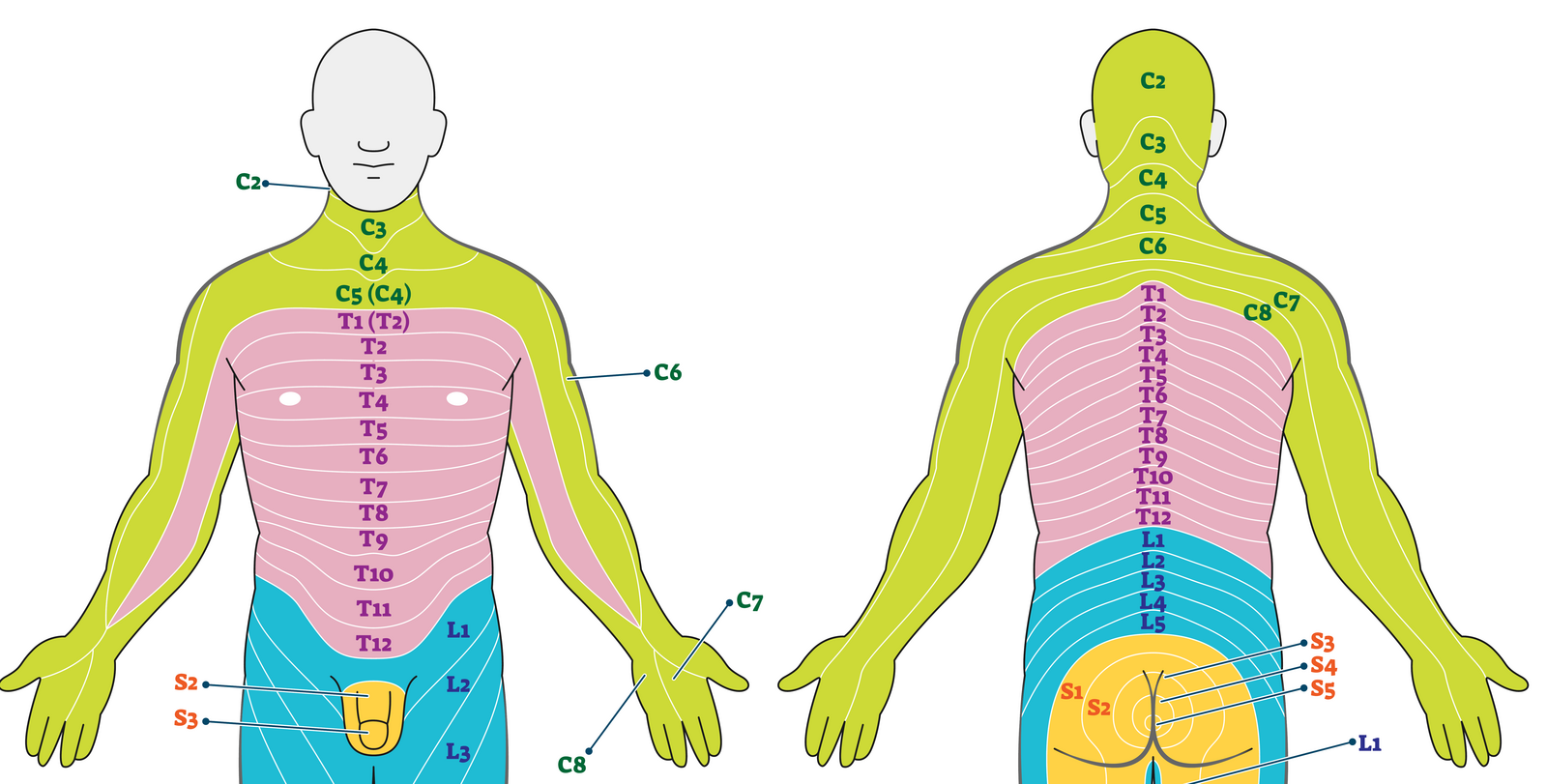
Caption: A dermatome map - the areas of skin supplied by each spinal nerve root. Note the green territory marked C5 and C6: it covers the shoulder, the outer upper arm, and continues into the forearm and thumb. This overlap is the entire reason cervical radiculopathy is mistaken for a shoulder problem. A compressed C5 root produces pain across exactly the area a patient would point to and call their shoulder. The distinguishing detail is how far down the pain travels - nerve pain follows these bands past the elbow, whereas shoulder pain usually stops around the deltoid.
The Distinguishing Features
The most useful single question is: does the pain travel past your elbow? Shoulder problems rarely refer pain below the elbow. Neck problems frequently do.
| Points to the shoulder | Points to the neck | |
|---|---|---|
| Pain location | Outer upper arm, stopping around the deltoid insertion | Travels below the elbow into forearm, hand, or fingers |
| Numbness / tingling | Uncommon | Common - often in specific fingers |
| What makes it worse | Reaching overhead, lifting, lying on that side | Neck position - looking up, turning the head, extending the neck |
| What makes it better | Resting the arm, avoiding overhead use | Putting the hand on top of the head (shoulder abduction relief sign) |
| Passive motion | Often painful when someone else moves your arm | Usually painless when someone else moves your arm |
| Weakness pattern | Specific to one movement, e.g. lifting out to the side | Follows a nerve pattern - may include grip, wrist extension, or triceps |
| Reflexes | Normal | May be diminished at biceps, brachioradialis, or triceps |
| Night pain | Classic - worse lying on that side | Present, but often related to neck position rather than side |
| Neck pain | Absent | Often present, though not always |
Two of these warrant emphasis, because they are the most reliable in practice:
The passive motion test. If someone else lifts your relaxed arm through its full range and it does not hurt, but lifting it yourself does, that points toward the shoulder - a torn or irritated tendon hurts when it is asked to contract. If your arm can be moved freely in every direction without reproducing your pain, the shoulder joint is less likely to be the source.
The shoulder abduction relief sign. Patients with cervical radiculopathy often discover on their own that resting the affected hand on top of the head relieves the pain, because the position takes tension off the nerve root. Patients with rotator cuff problems find that position uncomfortable rather than relieving. If you have found yourself sleeping with the arm overhead because it feels better, that is a meaningful clue - mention it at your visit.
It Can Be Both
Cervical spine degeneration and rotator cuff degeneration are both common in adults over 50, and they frequently coexist. Finding a rotator cuff tear on MRI does not establish that it is the cause of your pain. Likewise, finding disc degeneration on a cervical MRI does not prove the neck is responsible.
The scale of this is larger than most people expect. When investigators performed MRI scans on both shoulders of 602 randomly selected adults aged 41 to 76 - members of the general population rather than patients - rotator cuff abnormalities were present in 96% of shoulders that had no symptoms at all. Cervical degeneration follows a similar pattern with age. In other words, if you are over 50 and have a scan of either region, something abnormal is very likely to appear on it whether or not it is causing your pain.
(Ibounig T, et al. JAMA Intern Med. 2026;186(4):406–414. Discussed further on the rotator cuff tears page.)
This is the situation that produces unsuccessful treatment: an MRI identifies a structural abnormality, it is assumed to explain the symptoms, the abnormality is treated, and the pain persists - because the imaging finding was real but incidental.
The examination, not the MRI, identifies the pain generator. Imaging confirms what the examination suspects. Where the picture remains unclear, a diagnostic injection can resolve it: if a well-placed injection into the shoulder relieves your pain, the shoulder is the source. If it changes nothing, the neck warrants closer attention.
How I Approach an Unclear Case
When someone comes to me with shoulder pain, I examine the neck as part of the visit - not only when the shoulder examination fails to explain things. It takes very little additional time, and the alternative is discovering the neck three months into a treatment plan that was never going to work.
What I am looking for is whether the story and the examination agree. If the pain stays above the elbow, worsens with overhead reaching, and hurts when I move the arm, the shoulder is the likely source. If the pain travels into the forearm or hand, changes with neck position, and the arm can be moved through full range without reproducing it, I am thinking about the neck regardless of what a shoulder MRI shows.
The cases that call for slowing down are the ones where both regions look abnormal on imaging and the examination is equivocal. That is common in patients over 50, because degenerative findings are close to universal in both regions by that age. In those cases I would rather use a diagnostic injection to answer the question than proceed on an assumption - if a well-placed shoulder injection relieves the pain, we have our answer. If it does not, we have learned something equally useful.
Where the neck turns out to be the source, cervical spine care is not what I do - but it is something I am closely connected to. Depending on the picture, I refer either to a non-operative spine specialist (a physiatrist) or to a spine surgeon. Most cervical radiculopathy does not need an operation, so the physiatrist is frequently the right first call.
A word on what a physiatrist is, because the title is unfamiliar to most patients. A physiatrist is a physician specializing in physical medicine and rehabilitation - non-surgical management of musculoskeletal problems. Many have additional subspecialty training in spine, in sports medicine, or in both, which matters here: a physiatrist with that combined background can often manage a shoulder problem and a cervical problem together, non-surgically, rather than treating one and referring out for the other. For a patient with contributions from both regions, that can be the most efficient place to start.
In practice the three of us often end up working together on the same patient, and that is not unusual - the overlap between cervical spine and shoulder problems is substantial enough that co-management is the norm rather than the exception. A patient may have a genuine rotator cuff problem and a genuine cervical problem, each contributing something. Sorting out which is producing which symptom, and treating them in a sensible order, works considerably better when the shoulder side and the spine side are actually talking to each other.
What I can offer is an accurate answer about where the pain is coming from, and a direct route to the right colleague when the answer is the neck.
Other Conditions in the Same Territory
Shoulder-region pain has a few other recognized sources:
Frozen shoulder - the key feature is that passive motion is also lost. If someone else cannot rotate your arm outward, that’s a capsular problem, not a nerve problem.
Scapular dyskinesis - abnormal shoulder blade mechanics, often related to posture and desk work, producing pain around and between the shoulder blades.
Thoracic outlet syndrome - compression of nerves or vessels between the collarbone and first rib, causing arm pain and heaviness, often worse with the arms elevated.
Suprascapular nerve entrapment - a specific nerve compression producing deep posterior shoulder pain and weakness in external rotation.
Parsonage-Turner syndrome (brachial neuritis) - sudden, severe shoulder pain lasting days to weeks, followed by profound weakness. It is uncommon, frequently misdiagnosed, and important to recognize because it’s usually managed non-surgically.
Referred pain from organs - gallbladder, diaphragm, and heart can all refer to the shoulder. Shoulder pain accompanied by chest pain, shortness of breath, sweating, or nausea requires emergency evaluation, not an orthopaedic appointment.
Red Flags Requiring Prompt Attention
Seek urgent evaluation for:
- Shoulder or arm pain with chest pain, shortness of breath, sweating, or nausea - cardiac symptoms can present this way, particularly in women
- Progressive weakness in the hand or arm
- Problems with balance, walking, or fine motor tasks like buttoning a shirt, or bowel or bladder changes - these suggest spinal cord compression rather than a nerve root
- Fever with severe shoulder pain
- Unexplained weight loss with night pain
- Severe pain following significant trauma
How the Source Gets Sorted Out
A thorough history and physical examination identify the source in most cases. The evaluation should include neck range of motion and provocative neck maneuvers, full shoulder examination including passive motion, a neurologic examination of the entire arm, and reflex testing.
Additional studies when needed:
- Shoulder X-rays for arthritis, calcific deposits, and cuff-related changes
- Cervical spine X-rays for disc space narrowing and foraminal spurs
- MRI of shoulder or cervical spine, chosen based on what the examination suggests
- EMG/nerve conduction studies when nerve involvement is suspected but the level is unclear, or to distinguish radiculopathy from a peripheral entrapment
- Diagnostic injection - often the most decisive test in an ambiguous case
If your evaluation has focused only on the shoulder and treatment has not helped, ask directly whether your neck has been examined. That is a reasonable question, and the answer may redirect your care usefully.
Frequently Asked Questions
How do I know if my shoulder pain is coming from my neck?
The most reliable indicators are pain that travels below the elbow, numbness or tingling in the fingers, pain that changes with neck position, relief when you rest your hand on top of your head, and a shoulder that can be moved passively through full range without reproducing the pain. Shoulder-source pain typically stays above the elbow, worsens with overhead reaching, and hurts when the arm is moved.
Can a pinched nerve in the neck cause shoulder pain without any neck pain?
Yes. Cervical radiculopathy can present with shoulder and arm pain and no neck pain at all - which is exactly why it’s frequently missed. The absence of neck pain does not rule out the neck as the source.
Can I have both a rotator cuff tear and a neck problem?
Frequently. Both cervical degeneration and rotator cuff degeneration are common after age 50 and often coexist. The presence of a tear on MRI does not establish that it is causing your symptoms - in a general-population study, rotator cuff abnormalities were found in 96% of shoulders with no symptoms whatsoever. A careful examination, and sometimes a diagnostic injection, determines which structure is responsible.
What is the shoulder abduction relief sign?
It’s the observation that placing the affected hand on top of the head relieves arm pain caused by cervical nerve root compression, because the position reduces tension on the nerve. It is fairly specific for cervical radiculopathy. Patients with rotator cuff problems generally find that position uncomfortable rather than relieving.
Will physical therapy for my shoulder help if the problem is my neck?
Generally not, and this is one of the more common reasons a course of shoulder therapy produces no change. Shoulder-directed therapy does not address nerve root compression in the cervical spine. If several weeks of well-directed shoulder therapy has not helped, that is useful information in itself and should prompt reassessment of the diagnosis rather than more of the same treatment.
Does cervical radiculopathy require surgery?
Usually not. The majority of cases improve with time, physical therapy directed at the neck, anti-inflammatory medication, and sometimes an epidural steroid injection. Surgery is considered for pain that persists despite dedicated non-surgical care, or for progressive weakness. Cervical spine care is outside my practice - depending on the situation I refer either to a non-operative spine specialist (a physiatrist) or to a spine surgeon, and most patients do not end up needing an operation.
Should I see a shoulder specialist or a spine specialist first?
Either is reasonable, and the more useful question is whether the physician you see will examine both regions. A shoulder evaluation that does not include the neck can miss cervical radiculopathy entirely, and the reverse is equally true. If your symptoms are clearly localized to the shoulder and worsen with overhead reaching, a shoulder specialist is a sensible starting point. If pain travels below the elbow with numbness or tingling in the fingers, the neck deserves attention first. One thing to expect: the first spine referral is often to a physiatrist - a physician specializing in non-surgical musculoskeletal care - rather than to a surgeon, since most cervical radiculopathy is managed without an operation. Some physiatrists hold additional subspecialty training in spine, in sports medicine, or in both, and those physicians can often manage a shoulder problem and a neck problem together without surgery.
What if I have both a shoulder problem and a neck problem?
This is common enough that it is close to expected in patients over 50, and it is managed by treating both rather than choosing between them. In practice that usually means a shoulder specialist and a spine specialist working together, deciding which problem is contributing more to your symptoms and treating them in a sensible order. The overlap between the two regions is substantial, and co-management tends to work better than sequential referrals in which neither physician sees the whole picture.
One efficient option in this situation is a physiatrist with subspecialty training in both spine and sports medicine. Because their expertise spans both regions, they can often manage the shoulder and the neck together non-surgically, which spares you from being handed back and forth between two practices while each treats one half of the problem.
Not sure where your pain is coming from? Dr. Gabriella Ode is a fellowship-trained shoulder and sports medicine surgeon at the HSS Sports Medicine Institute. A thorough evaluation of both the shoulder and the cervical spine is part of every shoulder consultation - because identifying which one is producing your pain is what determines whether treatment works. Request an appointment or request a remote second opinion.
Financial disclosure.
Dr. Ode is a paid consultant for Advita Ortho and ConMed, manufacturers of orthopaedic implants and surgical instrumentation. These relationships are reported publicly through the CMS Open Payments database. She receives no compensation for this website, and no compensation is tied to any individual patient’s treatment decision. Her complete financial disclosures are available here.
This article is for general education and is not a substitute for individual medical advice. Please consult a physician about your specific condition.